
The Number That Keeps Growing
Housing Insecurity is obviously a major epidemic in the United States and across the world. Most citizens in the United States are aware of this. With that being said, there has been little to no progress within the issue. The US Census shows that in 2010, there were around 430,000 homeless Americans. Ten years later, in 2020, that number has increased to 580,000.
Most people are aware that this is an ongoing issue in the United States but do they want to help? People generally want their community, city, state, or country to be a better place. The more efficient society is, the better it is for everyone. Additionally, a UC Berkley “Greater Good” article states, “our strands of evidence suggest the following. Compassion is deeply rooted in human nature; it has a biological basis in the brain and body. So, it makes sense that citizens would want to give back to the less fortunate. This is not to say that people are not helping the homeless or do not care.
Is it inevitable?
I was no different than any other American. I knew housing insecurity was a major problem in our country but I never took the time to really learn the levels of homelessness. As a class, we had conversations about how homeless individuals feel invisible. There were many scenarios where homeless individuals felt as if people didn’t look at them like they’d look at anyone else walking around the street. Dialogue continued to occur and we were all disheartened and frustrated that this was the case. I started to ask myself the question of why that is the case? Then I thought, is homelessness inevitable? No American alive today knows of a world where everyone in their country has a place to sleep. Sure, the numbers have swayed but throughout everyones lives, homelessness has existed. Because of this, it causes people to become numb to the problem.
So, is homelessness inevitable? This exact question was on my mind the entirety of the semester. Contrast to popular belief, I do believe that homeless is inevitable. This is not to say that it is not an issue and we as a country are perfectly fine where we are. 580,000 people being without a home is unacceptable. But, with over 320 million people in our vast country, it is impossible we have the number of homeless people be zero. An article from The Guardian is titled “Homelessness is not inevitable and can be solved – these cities show us how”. In this piece of writing, it shows examples of 85 US cities that have adopted a program named “Built for Zero”. This program works by, “strengthening data-driven systems that can continuously reduce homelessness for populations”. The key is reduce. Reducing the number of homeless individuals is more than achievable if we take the right approach.
The Fight
When I was in high school, I participated in many community service activities. I’ve volunteered at food pantries, handed out items and food to the homeless among many other acts. A lot of Americans have done the same. We need to do our best to provide resources to the homeless and get them back on their feet. As great as that is, it is not going to help put an end or greatly reduce the number of homeless people in the United States. In order to stop the number of homeless people from growing, we must look at the root of the problem.
The Brain and Behavior Research Foundation claimed, At a minimum, 140,000 or 25 percent of these people were seriously mentally ill, and 250,000 or 45 percent had any mental illness. By comparison, a 2016 study found that 4.2 percent of U.S. adults have been diagnosed with a serious mental illness (Homelessness and Mental Illness: A Challenge to Our Society). It is clear, not only do we have a housing crisis, we have a mental health crisis. As perviously stated, there were an estimated 150,000 more homeless people in 2020 than there were in 2010. In that same ten year gap, suicide death rates increased by 25% or more in 9 states. There are a lot of examples of people that would say that homeless people are “lazy” or “need to get up and get a job”. First of all, many of homeless individuals do not have a permanent address among other resources that restricts them from getting a job. Secondly, many of these people are suffering. They are suffering from a battle within their own mind that only they know. An individuals cognitive or behavioral problems can make it extremely difficult to sustain a job and relationships. This, in turn, makes it very challenging to obtain stable housing.

Mental illness has increased due to a variety of reasons. The food we eat, social media, societal pressures, and an abundance of different personal circumstances. It is also a two way street when it comes to unstable housing situations and mental health disorders. Studies have shown that becoming homeless or growing up homeless can influences a persons mental illness symptoms. Being in a situation of homelessness will also often lead to higher levels of psychiatric distress. It is a vicious cycle that millions of people have had to or are going through.
Addiction
Homelessness, Mental illness, and addiction are all at the top of our most significant issues as a society. Unfortunately, they are all linked and apart of the same cycle. This graph demonstrates the amount of overdose deaths in the United States throughout the years according to the CDC.
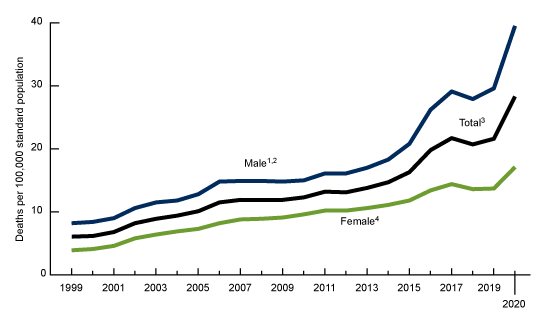
When we look at that ten year period from 2010-2020, we can see the number of overdose deaths grow dramatically. Just as we saw homeless numbers increase and mental illness increase. American Addiction Centers states, “Most research shows that around 1/3 of people who are homeless have problems with alcohol and/or drugs, and around 2/3 of these people have lifetime histories of drug or alcohol use disorders. According to SAMHSA, 38% of homeless people abused alcohol while 26% abused other drugs.” Many people suffering from mental health disorders feel the need to self medicate because they were not offered or aware of the resources needed to manage their mental health.

The connection is clear. It is not a matter of one issue causing the other. They all feed off of each other and create this awful situation we have with hundreds of thousands of people struggling everyday.
The Next Step
Yes, we all need to give back to the community and look out for those in need. Handing out peanut butter and jellies and donating your old clothes is awesome. If we really want to make an impact, we need to start looking at the root causes of the problems that we have. None of these issues above is more important than the other because if we achieve progress in one, we’re achieving progress in all.
So how do we achieve progress? Unfortunately, there is not one, simple answer but there are many things that we could improve.
- Make mental health screenings universal. “Policy makers should take action to make universal mental health screenings a routine part of primary care services. This will help identify symptoms earlier, thus allowing providers to have a baseline of patients’ mental health status and then track improvements over time. Only by assessing mental health and measuring clinical improvements over time will we know if people are getting healthier from treatment, and which providers are successful at treating specific conditions.” (Too Big To Ignore: 7 Recommendations To Address Our Growing Mental Health Crisis)
- End the stigma about mental health. “A publicly funded, multimedia public awareness campaign on mental health could have wide-reaching effects on stigma. Similar campaigns have been shown to shift perspectives, norms, and behavior in a range of contexts, including mental health in New Zealand and Australia. The corporate world, in parallel, plays no small role in influencing norms through advertising. Mental health destigmatization should become a strategic element of corporate social responsibility agendas in the coming years. At the same time, state and federal policies should focus on bolstering mental health education programs in schools and workplaces across the country.If the United States is to advance in its mental health, the veil of stigma must fall.” (6 Real Policy Solutions to the U.S. Mental Health Crisis)
- Widen the accessibility to Mental Health Care
- Accessibility to medication to cope with drug withdrawals
Final Personal Thoughts
I’ve learned a lot throughout the semester and my perspective has changed. I have been made aware of everything that the homeless community has to deal with and goes through. The contributing causes to homelessness is clear to me. I believe that all Americans must push for improvement on the housing crisis through attacking the root of the problem. That is the only way we will be able to see dramatic changes for the better when it comes to homelessness. It is not an easy feat but I do believe if we push the idea that we must work from the bottom up, it is achievable.
Sources
About the Author Dacher Keltner UC Berkeley Dacher Keltner, and Dacher Keltner UC Berkeley Dacher Keltner. “The Compassionate Instinct.” Greater Good, https://greatergood.berkeley.edu/article/item/the_compassionate_instinct.
“Built for Zero: Working to End Homelessness.” Multnomah County, 23 Nov. 2022, https://www.multco.us/johs/news/built-zero-working-end-homelessness#:~:text=What%20is%20Built%20for%20Zero,continuously%20reduce%20homelessness%20for%20populations.
Courtenay, Tamsen. “’The Worst Part of Being Homeless Is Feeling Invisible’.” Evening Standard, Evening Standard, 8 Jan. 2020, https://www.standard.co.uk/homeless-fund/the-worst-part-of-being-homeless-is-feeling-invisible-a4329671.html.
Fraieli, Andrew. “Opinion: Homelessness Is Not Inevitable.” Homeless Voice, 1 Feb. 2021, https://homelessvoice.org/opinion-homelessness-is-not-inevitable/#:~:text=Homelessness%20is%20not%20inevitable.,not%20inherently%20bound%20to%20happen
“Homelessness Is Not Inevitable and Can Be Solved – These Cities Show Us How.” The Guardian, Guardian News and Media, 10 Dec. 2019, https://www.theguardian.com/cities/2019/dec/10/homelessness-is-not-inevitable-and-can-be-solved-these-cities-show-us-how.
“Substance Abuse & Homelessness: Statistics & Rehab Treatment.” American Addiction Centers, 14 Sept. 2022, https://americanaddictioncenters.org/rehab-guide/homeless.
Too Big to Ignore: 7 Recommendations to Address Our Growing Mental … https://www.healthaffairs.org/do/10.1377/forefront.20201210.312139.