
[su_tabs]
[su_tab title=”Thesis & Background”]
Thesis & Background
I will be researching Robert Frank and his photobook The Americans, specifically through the lens of an outsider looking in and the push-pull of opposing concepts within his photographs. Frank’s Jewish-Swiss immigrant background is what allows him to notice the subtle moments he captures. As seen in his photographs, his status as an outsider and a Jew give him the ability to see the interplay between Americans with different cultural identities. In an interview with the San Francisco Museum of Modern Art, Frank discusses his work in The Americans. He explains it is better to photograph in a small atmosphere to get a more intimate look at his subjects. He also learned about the country by taking trips throughout it and stated that the places that interested him the most were “on the way.” Critics – like Susan Greenbough, praise Frank’s ability to stand on the margins of society and notice aspects about people that they are not able to see. She explains that he has a clearer ability to see the truth from his status as a European immigrant at the margins. I will use this lens and his personal context as a Jewish immigrant to honor three photographs from The Americans: San Francisco (1956); Parade – Hoboken, New Jersey (1955), Indianapolis (1958).
Frank’s work here is captivating to me because he hones in on themes that are inherently ‘American,’ which myself and many others accept as standard. The images he captures encapsulates our obsessions with cars, machinery, religion, the American flag, and interactions between diverse people. His work inspires me because of how his status as an outsider can show an honest depiction of the insiders, teaching us more than we would learn on our own. Frank photographs, among the earlier themes I mentioned, the liminal space between destinations – which would be physical space or metaphorical space. His attention to politics, religion, and car culture call out traditional American ways. His Jewishness and immigrant status are the reason he is able to photograph the subtle moments he chooses, which then speak volumes even today. Though Frank does not speak about his Judaism, he still includes a photo of ‘Yom Kippur’ in his representation of Americans, where many others may not have. Frank’s experience getting arrested is correlated to his work showcasing politics and political divide. Finally, what makes his work iconic is that he is able to use his outsider status to shine a light on American ideals and culture in the 1950s with an ethnographic eye, often giving attention to aspect of our lives that the privileged tend to ignore.


[/su_tab]
[su_tab title=”Methodology”]
Methodology
The main themes of Robert Frank’s The Americans, indicated by what he chose to photograph, included automotive culture, marginalized or overlooked people, the American flag, cowboys, machines, religion and religious institutions, and interactions between people. As state in an interview with the San Francisco Museum of Modern Art, his favorite places to take photographs were “on the way.” He was interested in the journey, not the destination, and the encounters along his trips. Frank was not interested in getting people to perform or pose for him, and he was also not interested in staging photographs. He incorporates both movement and stillness in his photographs, depending on the moment. If he wants to emphasize the isolation of a person or draw attention to something the viewers aren’t used to seeing (such as in Elevator – Miami Beach) he will use a long exposure time to capture movement. Frank’s photos were all black and white, but he was focused on both composition and subject matter to focus in on aspects of life we aren’t used to looking at. I will take black and white photographs focused on the main themes of Frank’s book, while also exploring these themes in the context of my own life. This weekend I will be spending time in Detroit, a place much less familiar to me than Ann Arbor, so I intend to notice and photograph these differences – where I may seem like an outsider. I will be using my phone camera, so it will be interesting to explore different photo editing mediums to emulate long exposure time or show movement in the photos.

Frank discusses his methodology for The Americans in the following clip.
https://www.sfmoma.org/watch/robert-frank-photographing-americans/
[/su_tab]
[su_tab title=”Photo Analysis”]
Photo Analysis
The experience of taking my own photos gave me new insight about what it must have been like for Robert Frank to photograph the way he did. He was able to capture the iconic moments because he was always observing and always had a clear sense of his surroundings and social situations. The weekend I took photos for this project I found myself seeing my familiar landscape differently, as I focused on the themes of the American flag, automobile culture, and social interactions. I used my cellphone as my camera, so I did not garner the same reaction as Frank probably did carrying a camera every where, but I can imagine the power that may have. Even simply taking my phone out to take pictures I felt I was drawing attention to myself. Frank’s process of taking photos along the way and on the journey also shaped how I started to see the environment around me. I was more engaged with looking around and noticing subtle elements in familiar spaces, such as campus, and unfamiliar spaces, such as the Detroit Institute of Art. I learned that Frank had to develop a keen eye for experiences that people live every day and how he had to be paying attention throughout the journey, not just at the destination.
After taking photos for myself, looking back at Frank’s images gave me a newfound understanding about what he must have gone through or felt when he was taking pictures. The need to understand my surroundings and notice different themes and patterns while walking through various spaces was probably only a sliver of what Frank experienced when traveling across the country. Reflecting on my own experience taking pictures, I acknowledge how focused he must have been on his trips – noticing aspects of life that many people would miss. I believe this has to do with his artistic and ethnographic eye, as well as the social power of holding a camera at all times.
One image that struck me differently after I took my own photos was Parade – Hoboken, New Jersey. This is because of how closely Frank had to have been observing the area he was in, in order to capture this moment representing blind patriotism, wealth disparities, and various social commentaries. The image is powerful because of how the flag is blocking the wealthier woman’s face, commenting on the idea of patriotism over identity, and how the working class woman (denoted by more worn clothing) is not covered or protected by American ideals. Capturing this moment would not have been possible if Frank didn’t travel around with a camera and look for moments along the way, walking the parade. Before I took my photos, I didn’t understand the extent to which Frank had to be paying attention to the passersby or his surroundings. This attention to the uncommon spaces are what allows him to produce such incredible images.
The characteristics I didn’t notice as much when taking the pictures, versus analyzing them afterwards, was the social message associated with them. In the selected photos section of the Photo Analysis page, I was able to draw much deeper meaning about American values and liminal space than I had thought about when I was taking the photographs. The photograph on the left shows the American flag that flies in the diag, between the branches of a large tree. The tree branches frame the flag in a balanced way and the trees and building in the background provide scale and perspective. This photograph is special to me because it draws on Frank’s theme of the American flag and how it permeates our culture. Students walk by this scene every day, but I have hardly stopped to look at how beautiful it is through the tree branches. In another vain, one could say that patriotism is forever permeating in our culture, as it shines through even a large tree.
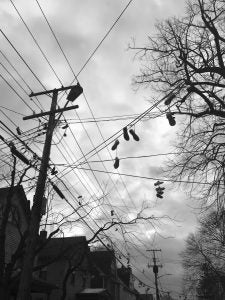
The photograph on the left is a photograph of shoes hanging on electrical lines, which includes the top of trees and top of houses as well. This photo I captured on my walk home, and it is a view I see every day. This was taken on my street and I found the composition to be quite profound. But when I started to think about this image I realized how much it represents liminal space and students’ looming and uncertain futures that wait after college. When Seniors graduate, on my street in particular, they throw a pair of old shoes over the wires to leave their mark on the street and as an homage to their time there. As soon as I moved in at the start of my Junior year my roommates and I were thinking about which pair of shoes we would leave as a mark on this street and our time at Michigan. It may seem trivial but these shoes represent the uncertain future, the nostalgic past, and college experience.
Reflecting on the photos I chose of Robert Frank’s and the photos I took inspired by Frank have allowed me to think deeply about his ethnographic eye and what being Jewish has meant to his photographs. A quote from Richard Woodward’s piece Behind a Century of Photos, Was There a Jewish Eye? encapsulates how I see Frank as both a Jewish photographer and an ethnographer. Woodward’s interpretation of Kozloff’s representation and analysis of Jewish photographers is: “Wrestling with issues of cultural assimilation, Jewish photographers devoured New York with their cameras while at the same registering a sense that they stood apart.” (Woodward, 2002) Frank was able to become close with some of the people he photographed, but as a white male he was able to look at whatever he wanted. His Jewish heritage, immigrant status, and accent kept him as an outsider however. This push and pull between being accepted and being an outsider is what allowed him to capture the iconic moments he did. As far as the ethnographic eye, this notion of being insider enough to be allowed to ‘look’ and outsider enough to still be able to get a more holistic view of a new culture is essential to Frank’s work. Similar to John Gutmann’s work focusing on car culture and American customs, we can draw many parallels between the certified ethnographic eye of Gutmann and my argued ethnographic eye of Robert Frank. (Philips, 2000)
Gallery
[Best_Wordpress_Gallery id=”115″ gal_title=”Robert Frank Inspired Images (Carly Rosenberg)”]
Selected Images

Slideshow 1 (My Photos)
[Best_Wordpress_Gallery id=”123″ gal_title=”Slideshow Carly Rosenberg”]
Slideshow 2 (Robert Frank’s Photos)
[Best_Wordpress_Gallery id=”204″ gal_title=”CMR Frank Slideshow”]
[/su_tab]
[su_tab title=”Conclusion”]
Conclusion
After I took my own photos, I understood my thesis more thoroughly and was able to add more central ideas to it. I argue that Frank’s approach to representing America can be considered as him having an ethnographic eye, because of his position an outsider as a Jewish-Swiss immigrant. This unique position allowed him to see things that Americans wouldn’t necessarily see in themselves, but his appearance as a white male allowed him to enter into unfamiliar spaces and take photos. My central idea has expanded to including the important of the journey to Frank’s work and to my experience photographing around Ann Arbor and Detroit. Beyond understanding more deeply how focused Frank had to be on his journeys and know when to take a photo, I realized the importance of noticing my surroundings. I didn’t realize until after I had to analyze my photographs, but one of the main themes I picked out of The Americans was regarding the concept of the journey. I would evolve my thesis or central guiding idea to be more focused on this “on the way” concept discussed by Frank. My photographs were taken on the journey through campus and walking from my house to campus, places very familiar to me but where I haven’t taken the time to notice intricacies of American culture. These locations are places I walk by every day and it speaks to Frank’s technique that I was able to pull out even more nuance and American values from just paying attention to the environment around me more closely.
I believe that my position as a Jewish American woman in the 21st century allows me to have somewhat of a nuanced lens when looking at Frank’s photos, but also requires me to challenge notions that I accept as normal. Themes such as car culture are built into my every day schema, so when I started to pay attention to this during the period of this project, I was able to notice how prevalent it is. It is so engrained in our culture, that I hadn’t even noticed or thought about it as being inherently ‘American’ to outsiders. This also has to do with global technological advancements as cars have become commonplace, where it was not as common when Frank was taking his pictures.
As I delved deeper into my Selected Photos, I thought about how my journey was similar and different to Frank’s. Frank was drawing on mostly unfamiliar topics to him and he was traveling in unfamiliar places drawing out pieces of American culture and values. I was able to do this on a much smaller scale, but in an environment that I am very familiar with. This experience allowed me to understand Frank more deeply because of how much I had to consider my surroundings and keep a keen eye to aspects that represent American culture. In conclusion, taking my own photos allowed me to develop my central idea and gain a deeper understanding of what Frank went through and looked for when photographing The Americans.
[/su_tab]
[su_tab title=”Sources”]
Sources
Alan Trachtenberg, “Is there such a thing as a Jewish eye?” PaknTreger 41 (Spring 2003), 20-25.
LensCulture, R. F. (n.d.). The Americans – Photographs by Robert Frank. Retrieved April 15, 2019, from https://www.lensculture.com/articles/robert-frank-the-americans (Images cited)
Maher, J. (2018, August 09). The Foreigner’s Road Trip – Robert Frank’s America. Retrieved from https://www.jamesmaherphotography.com/new-york-historical-articles/the-foreigners-road-trip-robert-franks-america/ (Images cited)
National Gallery of Art. (n.d.). Retrieved April 15, 2019, from https://www.nga.gov/features/robert-frank/the-americans-1955-57.html (Images cited)
Richard B. Woodward, “Behind a Century of Photos, was there a Jewish eye?” The New York Times, July 7, 2002.
San Francisco Museum of Modern Art. (2018, December 03). How Robert Frank Shot his Street Photography Masterwork, The Americans. Retrieved from https://www.youtube.com/watch?v=9kMwnmrL5FM
Sandra Phillips, “John Gutmann: Culture Shock,” Culture Shock: The Photography of John Gutmann (1999), 15-39.
[/su_tab]
[/su_tabs]
Robert Frank, The Americans
Carly,
You’ve chosen three good photographs from Frank’s book and you articulate clearly his position as a Jewish immigrant outsider to the U.S. Would you consider that Frank, too, possesses what we’ve been calling an ethnographic eye? How do his photographs compare with those of John Gutmann, for example? As you explore this project, keep in mind the challenge you face to try to see aspects of American life as Frank did.
DDM
Carly,
Glad to see that you’ve started to take some photographs. You summarize elements of Frank’s approach, the most important of which is his journey. I like how you plan to try to emulate that in a place that is mostly familiar to you. Going to parts of Ann Arbor you have never seen is a good idea. It’s also a good idea to put down your sources as you use them so that you don’t have to scramble later on to find them again.
DDM
Carly,
You’ve taken some very good photographs and the slide show that you assembled works very well. It’s not easy to pick up on some of the themes that Frank develops in his book, but I think that you’ve captured some elements. Did you ever get to unfamiliar parts of Ann Arbor?
DDM
You’re missing the photo analysis tab. Please insert it.
Carly,
This is an excellent final project. I think that all of the pieces work well together. You made a good choice of video, your discussion of your own photographs is illuminating, and your conclusion brings together many of the relevant themes, especially those of ethnography, which combines insider and outsider perspectives. I am glad that you recognized the complex position that Frank occupied as a white male, but also as a foreign Jew. These two elements combine and conflict, and help to produce the photographs he took. Similarly, your own reflection on your social position helps to situate your photographic choices.
DDM
Carly,
I really appreciate the effort that you put in to capturing photographs similar to what Frank’s mission was. After looking at your photographs, I believe that I was able to gain a deeper understanding of Ann Arbor. After four years of walking around campus, it is hard to stop and appreciate the small details that help to define and make Ann Arbor what it is.