“The Big Issue” in the industry
Marginalized individuals have fallen victim to homelessness and dehumanization. The lack of true empathy in society has led to the flourishing of degradation. With little to no perseverance, they have resorted to the falsities of hopeful begging. Panhandling has instilled a sense of burden and pity that dehumanizes an individual.
Street papers have challenged that ideal. In 1989, New York founded “Street News” and drastically changed the course of homelessness. Marginalized individuals became vendors and created their own source of income. They bought each paper for a certain sum and sold it for a higher sum. This helped to eliminate panhandling and restore dignity within the community.
New York’s “Street News” inspired the start of street papers all over the globe. In 1991, “The Big Issue” was founded in London. Since then, it has chained out to multiple countries such as South Africa and Australia.
Let the battle begin!
Follow along as “The Big Issue” street papers go head to head in three competitive rounds.
First, they prepare to test their ability to effectively design a functional website by analyzing their strengths and weaknesses.
Next, they compete to see which paper was most successful in reflecting on its community.
Lastly, they plan to be “Originally Distinct” by sharing their charm and flair to end the battle once in for all.
May the most effective paper win!
Getting to know our contestants
The Big Issue | United Kingdom
With over thirty years of experience, “The Big Issue United Kingdom” prides itself on changing lives through enterprise. They work under a shared mission to create opportunities for the impoverished. Since 1991, they have succeeded in helping over 100,000 marginalized people make an income. Their mission remains to support social justice in the United Kingdom.
“Changing lives through enterprise.”
The Big Issue | Australia
Since 1996, “The Big Issue Australia” has supported the creation of work opportunities for their marginalized community. They run multiple social enterprises in hopes of granting the opportunity for people to earn their own source of income. Their goal is to build the confidence of marginalized individuals and strengthen their community’s connection.
“We help people help themselves.”
The Big Issue | South Africa
Founded in 1997, “The Big Issue South Africa” strives to support marginalized individuals in taking responsibility for their lives. They have successfully sold over 140,000 papers each year. Their operation supports micro-entrepreneurship within their impoverished community and plans to expand it. They hope to help the marginalized take control of their lives by generating their own income.
“Change is in your pocket.”
Round #1: Design Complexity
Street papers greatly rely on the accessibility of their website in conveying the urgency of homelessness. Their website’s design and functionality build their foundation for success in the digital world. Vital information can be efficiently comprehended through an effective structure. Each paper will explore its strengths and weaknesses regarding the complexity of its design. What has it successfully mastered? Where can improvements be made? The paper with the strongest analysis will win this round!
#3: The Big Issue | South Africa
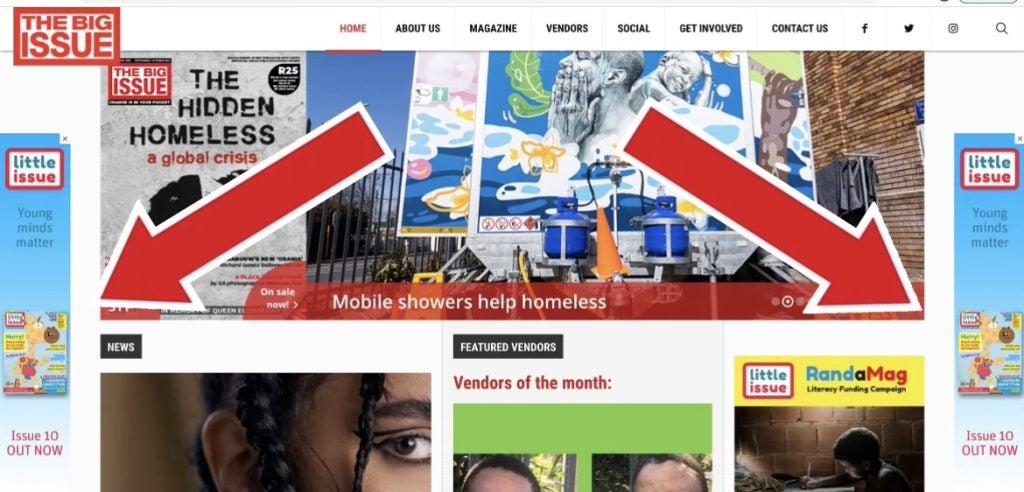
Coming in third place is “The Big Issue South Africa.” Their website was packed with information. They had a tab for just about everything. Their visuals were unique and intriguing. They also had their latest issue at the very top of the website. That made it both convenient and accessible to their viewers.
The website was dense with information yet it lacked a sense of direction. For starters, there were advertisements covering some of the material and driving attention away from the actual content. Not to mention the overall “busy” layout. It lacked a sense of organization. There were articles being thrown at the reader everywhere they looked. It was simply overwhelming.
South Africa was runner-up for second place, however, the United Kingdom won by a landslide. While the United Kingdom also had advertisements, they managed to keep them hidden until the viewers scrolled further. This could have been a more effective take on the inclusion of advertisements on South Africa’s website.
#2: The Big Issue | United Kingdom
Taking second place is “The Big Issue United Kingdom.” Straight away, the viewers notice a “Top Stories” column at the side of the page. It effectively captured the attention of the audience and alerted them of current world events. They also had a variety of tabs that took the viewer to different sections of their website.
While they had multiple columns for the viewer to explore, they all seemed rather “crowded” and took away from each other’s importance. There were photos and articles sprawled all over the website which could overwhelm the viewer. This led to their main issue- overcrowding. They had so much information packed into one page. This can be discouraging for new viewers.
“The Big Issue Australia” is an effective example of a simplistic and contemporary design. The United Kingdom can take notes regarding the concise layout of Australia’s website and perhaps implement that into theirs.
#1: The Big Issue | Australia
Leading in first place is “The Big Issue Australia.” They had a concise and clean website with little to no cluttering or overcrowding. Their website was contemporary which engaged well with newer generations. After all, it’s the newer generations who hold the greatest impact on the future. Most importantly, their website was not overwhelming at all. They utilized color blocking which enhanced the concise and modern feel of the website.
Sometimes simplistic designs are effective but they can also take away from the content. Oversimplification was borderline present on Australia’s website. There weren’t many tabs to explore on their website. This could potentially make the website “boring” or lack information.
Australia’s website managed to win first place mainly because of its concise and contemporary design. In comparison to South Africa and the United Kingdom, it was a “breath of fresh air” and easier to process- especially for newer generations. Congratulations to “The Big Issue Australia” for taking first place!
Round #2: Communal Reflection
A street paper’s goal is to reflect on its community in hopes of initiating positive change regarding impoverishment. However, certain papers integrate communal reflection more effectively than others. While “The Big Issue” papers have many similarities, they reflect on their communities in differing ways. Each street paper will be assessed on its ability to best reflect on its community. The paper with the strongest assessment will win this round!
#3 The Big Issue | Australia
Taking third place is “The Big Issue Australia.” They had a “community hub” tab that had multiple articles regarding current events, recipes, and vendor biographies. This allowed the viewer to connect to the vendors and possibly sympathize with their situations. The biographies contained information regarding the vendor as well as the importance of “The Big Issue” in their lives.
They did include biographies, however, there weren’t very many of them. There seemed to be as many biographies as there were recipes. That took away from their ability to reflect on the areas of their community that they aim to help. Perhaps they can remove a few of the recipes and replace them with more vendor stories to ensure that coverage is being fulfilled.
Australia landed in third place rather than second simply because South Africa included far more biographies. Their website had a whole page dedicated to the vendors. They had photos of each vendor which can be clicked to reveal their biography. This could be something that Australia’s website can implement into its structure.
#2 The Big Issue | South Africa
Coming in second place is “The Big Issue South Africa.” Their website dedicated a whole tab to the vendors. They had photos of each vendor which is a helpful tactic in appealing to emotion. Each photo contained a name and showed a biography when clicked on. The image of the vendor stayed in the minds of the readers. In turn, it helped the viewer sympathize with the vendor they were reading about.
While they had quite a few vendor biographies, they lacked mentioning much about them outside of their work for “The Big Issue.” For example, what unique accomplishments or personal stories resulted from working with “The Big Issue?” That type of information could entertain and intrigue the reader.
“The Big Issue South Africa” could have received first place, however, “The Big Issue United Kingdom” barely beat them. The United Kingdom had unique stories regarding its vendors rather than just biographies. This was a captivating aspect that South Africa could incorporate into its “vendors” tab.
#1 The Big Issue | United Kingdom
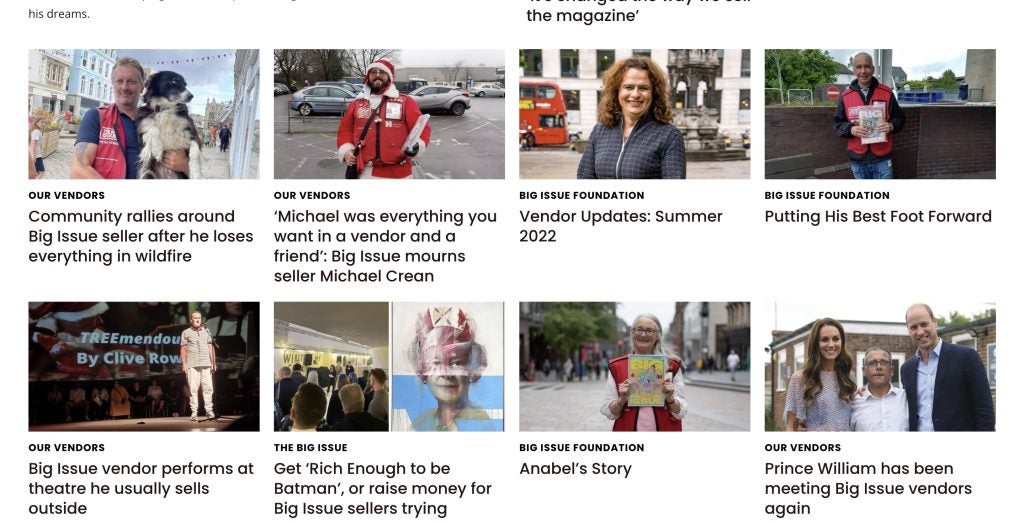
Taking the crown for first place is “The Big Issue United Kingdom.” Their website had a vendors tab that was eye-catching and informative regarding their community. They displayed multiple vendor stories speaking about unique opportunities that each vendor may have experienced. For example, one of these features spoke about a vendor who was writing a Dungeons and Dragons-inspired sci-fi novel. By incorporating information like this, the vendors acquire personality in the viewer’s minds. This may lead them to sympathize or even empathize with the vendor which can be the goal of a street paper.
However, at times a vendor may not have a “sob story” or an “interesting comedy” in their life. Therefore, the inclusion of the occasional biography or two could be effective. Between every few articles, there could be a biography to help introduce the vendors to the viewers. This can also enhance the sense of community by being able to recognize vendors and their locations.
Overall, the United Kingdom was worthy of first place. They effectively gave their vendors character and personality which helps the viewer to perceive them as more than just “homeless people” Congratulations to the United Kingdom for receiving first place!
Round #3: Original Distinctions
Originality is key to flourishing in the digital industry. When a paper is original, it obtains an intriguing character that may not be apparent in other papers. It captures and captivates the reader through unique distinctions. “The Big Issue” street papers tend to have similar layouts and characteristics, however, a few have their own charm and flair. Only one paper can be “Originally Distinct.” Which paper will win this round?
#3 The Big Issue | United Kingdom
Landing in third place is “The Big Issue United Kingdom.” Within their “vendor” tab they had the “find your local vendor” feature. Upon clicking it, it may just seem like a map of the United Kingdom with red and yellow spots representing the vendors. However, it is so much more interactive than just that. For starters, the yellow “spots” represent vendors that are accepting online subscription sales. This can motivate the viewer to support the vendor in various ways. Once the viewer clicks on a yellow “spot,” a little side panel is revealed. The panel gives basic information regarding that specific vendor. It also gives their location as well as an option to buy a subscription from them. Not only was this map interactive, but it also allowed options for those who may not be able to get out and physically buy a street paper.
While this option sets them apart from the rest of the papers, it would have been great to see actual images of the vendors when clicking on the yellow “spots.” Instead, the viewers see the same image of the back of a person wearing a “Big Issue” vest. It could have been even more connecting and possibly sympathy-inducing if the viewer was able to see who they were purchasing from.
The United Kingdom could have taken second place but they did lack details on their map which put Australia slightly ahead. Regardless, the United Kingdom stood out with its map.
#2 The Big Issue | Australia
Second place is held by “The Big Issue Australia.” They run multiple social enterprises focused on supporting the marginalized. Their website introduces six of them as well as links that lead to more information regarding each one. An intriguing program that quickly caught attention was the “Community Street Program.” It is an initiative founded by “The Big Issue” and based in Australia. The main aim of this program is to provide a safe environment for the homeless to participate in sports and make friends. They specifically chose soccer because it is a sport that ensures commitment and inclusiveness. They have created this program seeing as many have given up on “traditional support systems.” Their program does not involve any prior skill which is incredibly helpful for inclusivity.
“The Big Issue Australia’s Community Street Program” would be even more effective if it branched out to different sports. Perhaps they can create a football program or even a hockey one. While their reasoning for choosing soccer is understandable, it would still be interesting to have varying options.
Australia could have won first place but South Africa’s creativity took the lead! Nevertheless, Australia is impacting the lives of numerous marginalized individuals and discovering hidden talent!

#1 The Big Issue | South Africa
Leading in first place is “The Big Issue South Africa.” They had an extremely creative take on their vendor’s talent. Their website had a “Vendor Art” tab which was inspiring and astonishing to look through. They claim that “marginalized individuals receive an outlet for creative expression.” They also accept donations of art materials. They dedicate a whole page to showcasing the art vendors have created. There are themes that can be clicked on to further show artwork within them. The work can even be purchased. Many of these pieces have thought-provoking names which can lead the viewer to dwell on the lives of the marginalized. South Africa provides a beautiful way of expression and income.
This could and possibly should inspire “The Big Issue” to further invest in creating expressive forms of income for the homeless. Perhaps a writer’s workshop could be next on the list. Marginalized individuals could write poetry or memoirs and profit from them. All while they are able to express their thoughts and journeys. Creativity can be empowering at times when homelessness feels belittling. It is a movement that can provide so much more than just ink on paper. Investing in creativity is risky yet rewarding.
In many cases, homeless people are shunned. Art speaks volumes and provides a voice for the voiceless. Art could be their voice as well as their security. For supporting a creative expression and means of income, South Africa wins this round! Congratulations South Africa!

The winner of “The Big Issue” battle is…
Each paper has its own means of approaching society’s injustices. They all appeal to their audiences in unique ways. Every country takes initiative in differing forms. “The Big Issue” is a massive chain that provided opportunities for the hopeless and the homeless all over the world. It has inspired the creation of so many street papers and helped the helpless. The United Kingdom, Australia, and South Africa have all demonstrated that throughout their street papers. They have displayed their efforts to contribute to their community in varying ways. All three of them deserve to be applauded for their contributions to society!
In fact, there seems to be an even tie between “The Big Issue” street papers! Each paper has its own strengths and weaknesses. “The Big Issue United Kingdom” did the most effective job of reflecting on its community. “The Big Issue Australia’s” design complexity was the most simplistic and accessible. “The Big Issue South Africa” had the most original and unique distinctions. All three of the street papers won a category and tied for victory! Who do you think deserved to win the battle of “The Big Issue?”
Works Cited:
Bukowska, Marta. “Home.” The Big Issue, 12 Oct. 2022, https://www.bigissue.com/.
“The Big Issue Australia.” The Big Issue, https://thebigissue.org.au/.
“Home.” The Big Issue South Africa, 21 June 2022, https://www.bigissue.org.za/.
“Street Vendors : Issues and Their Importance – UPSC GS2.” IAS4Sure, 1 Feb. 2022, https://www.ias4sure.com/wikiias/gs2/street-vendors-issues-and-their-importance-upsc-gs2/.
Newsdesk. “The Big Issue Struggles to Sell to London’s Empty Streets and Cashless Hands.” South West Londoner, 7 Apr. 2022, https://www.swlondoner.co.uk/news/21012022-the-big-issue-struggles-to-sell-to-londons-empty-streets-and-cashless-hands.