The Origin of Street Papers
Spare Change News

Located in Cambridge, MA, Spare Change is the oldest street paper in the US. It was founded in 1992 by Tim Hobson with the intention of creating a space for homeless people to advocate for themselves while raising funds to alleviate the conditions of homelessness and eventually become housed (“Spare Change News”). Stemming from the original goal to improve awareness of homeless people, Spare Change News has been publishing articles that examine local and national politics. For the 30 years and growing that the paper has been running, Spare Change has been a template for other street papers around the US.
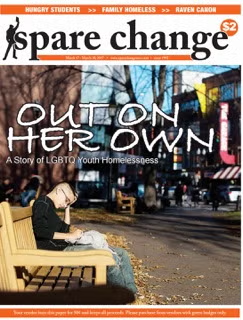
Today, Spare Change is distributed bi-weekly. Vendors purchase copies of the paper for $0.50 and sell them for $2 which earns them a $1.50 profit per paper (Spare Change News). Vendors may be homeless or low-income and selling the paper allows them to earn their daily income. Street papers also help break the narrative that homeless and low-income people are lazy or just unwilling to work. Homelessness is a result of many different factors, but laziness is not one of them.
Another one of the reasons for starting the paper was to spread the stories of homeless people and to increase awareness of the issues that homeless people face. Anyone, including vendors, in the Cambridge area that is interested in writing for Space Change, is able to apply. Spare Change News allows anyone in the community to report on local social justice issues.
The Spread of Papers
Street Roots
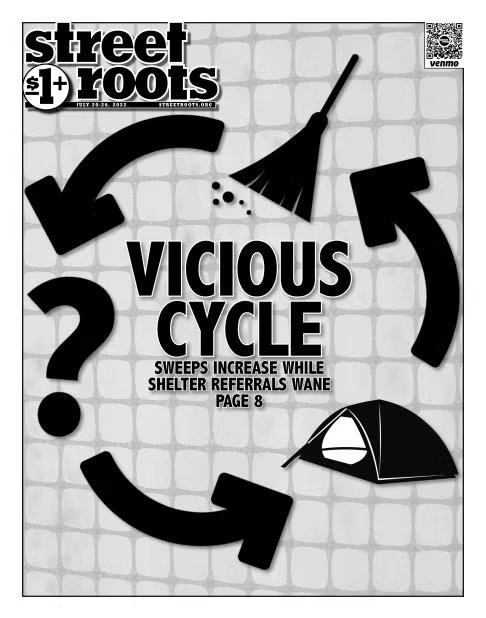
Street Roots is another street paper located in Portland, Oregon, and it has been running since 1999. Even though Street Roots started as a paper and continues publishing weekly, as an organization, the paper has used its resources to go beyond just being a news source.
Vendors purchase the Street Roots paper for $0.25 and sell it for $1. New papers are published weekly, and there are about 200 vendors at a time with a yearly total of 800 (“About”). Their slogan “for those who cannot afford free speech” encompasses Street Root’s desire to highlight the stories and voices of underrepresented people in the community. Thus, Street Roots allows community members, social-justice organizations, and other journalists to write for the paper. Just like Spare Change News, the main goal of Street Roots is to spread awareness of local and national social justice issues while providing a low-barrier income source (“About”).
While Spare Change’s main product is the paper, they also have a number of advocacy programs, such as an annual guide to help homeless people and people in poverty in the local area, a podcast, and an ambassador program. The growth of Street Roots from just a paper to a larger organization illustrates how other street papers can grow in the future.
Thrive Detroit

Thrive Detroit is a relatively new paper that was founded in 2011, and it’s the first street paper in the Detroit area. The paper is currently sold in Detroit’s Midtown, but they are looking to expand into north, south, east, and west Detroit (“Three Words” 1:22-1:32). While being a smaller paper, its impact on the community and its mission show exactly why street papers are important and impactful.
Copies are sold to vendors for $0.25, and vendors can sell the paper for $1. The paper is published 2 times a month. Readers can also opt-in for a $12 per year print subscription that can be mailed to them. There is also a digital subscription for $5 per year, however, the PDF versions are only distributed quarterly. The paper is also sold by Source Booksellers, a local bookstore, and D:hive, another local business. Wherever a reader chooses to purchase the paper, all proceeds go to the vendors. Another additive for vendors is selling ads in the paper. Vendors have the ability to earn 30% from all ad sales or formal referrals (“About”). This option is open to all vendors, and it acts as an extra incentive to become involved and grow the paper.
Thrive Detroit’s main goal is to establish micro-enterprises to help the homeless and people in poverty earn a living (“About”). The paper is one route, and Thrive Detroit is looking to create different micro-enterprise business models in the future (“Three Words” 1:38-1:48″).
More than a Paper
Micro-Financing
Each paper has its own micro-financing business model. Spare Change originally sold its paper for $1, and vendors would purchase their copies for $0.25. Now, Spare Change sells its paper to each vendor for $0.25, and the vendors can sell it to readers for $2 which makes them a $1.50 profit. However, Street Roots sells copies to vendors for $0.25, and the vendors sell them for $1, making a $0.75 profit. Thrive Detroit sells copies for $0.25, and the vendors sell them for $1, but the vendors also have the choice to sell ads for a 30% commission.
Since Thrive Detroit’s focus is on micro-enterprises, rather than just the paper, their business model differs greatly. Thrive gives vendors the option to sell the paper and/or sell ads in the paper. The emphasis is not on the paper but rather on the establishment of a micro-enterprise and micro-financing. The paper is just an added bonus. While Thrive’s model encourages the spread of social justice issues in the area, the real interest lies in actually making a financial difference in people’s lives.
The use of street papers as resources for the spread of awareness and access to low-barrier income sources presents a difficult dilemma. Can homelessness and poverty be reduced through increased awareness, or should the micro-financing model be more emphasized? Organizations always have to find the balance between performatism and activism.
Looking a little deeper, MIT’s Living Wage Calculator reports that the livable wages in the Boston-Cambridge, MA, and Portland-Vancouver-Hillsboro, OR areas are $22.56/hour and $20.84/hour for one adult, respectively. In the Detroit-Warren-Dearborn area, the livable wage is $16.20/hour. Based on each paper’s profit margin, Spare Change vendors would have to sell about 15 papers an hour to make the hourly wage. Street Roots vendors would have to sell at least 28 papers an hour to meet the livable hourly wage and Thrive Detroit Vendors would have to sell 22 papers.
Whether or not vendors are able to make these hourly sales rates can be examined using the cities’ population rates. According to the US Census Bureau’s QuickFacts statistics table, Portland, OR, has a population of about 640K people, Detroit has a population of around 632K, while Cambridge, MA only has a population of about 117K people.
All three papers seem to have a population base large enough to sustain the hourly sales rate. With some more calculations, if vendors are working full-time (2080 hours a year), Spare Change vendors would need to sell 31,200 papers a year, Street Roots would need 58,240 papers a year, and Thrive Detroit vendors would need to sell 45,760 papers a year. Each city’s population seems to be able to sustain these yearly sales rates, but whether or not vendors are actually able to sell enough papers to meet this living standard is unknown. Therefore the efficacy of this type of micro-enterprise is unknown. It would be interesting to see the average number of papers a vendor is able to sell in each location, which would allow others to see the financial success of street papers.
Changing the Narrative
Despite the financial structure, the ultimate benefit of a street paper is its ability to change the narrative around homelessness. Spare Change’s vision for creating a smaller paper that focuses on the hard-hitting issues of homelessness has been the model for almost all subsequent street papers. After 30 years, Spare Change continues to publish articles about social justice issues pertinent to the Cambridge area. Their recognition of the lack of acknowledgment of the hurdles that the homeless and people in poverty face opened the door for other communities nationwide to examine the same issues. Since Spare Change does not offer online versions of their paper, I have been looking at past covers of the papers to see what is being highlighted, and I present a few covers from over the years below.
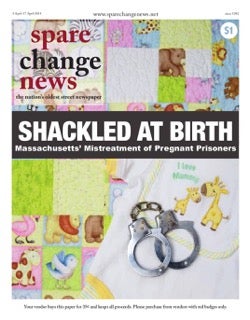
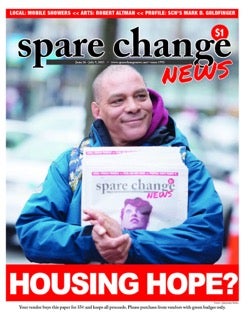

Based on the covers, Spare Change seems to examine current issues, as well as provide legislative or advocacy solutions. It is clear that Spare Change is focused on helping and healing the Cambridge and greater Boston areas.
Street Roots’ paper mostly focuses on community events and issues within the Portland area. There are special focuses put on social justice, housing, environment, culture, and opinions, as they are some of the main subpages on the website’s banner (Street Roots).
Street Roots also frequently highlights its vendors through “vendor profiles”. Each article is posted on the website and put on a special subpage for all of the profiled. Every active vendor has an article about their experiences being a vendor and working with Street Roots, as well as a photo of themselves and a quote expressing what they love most about being a vendor (“Vendors”). The inclusion of vendor profiles is useful for learning about the person who’s actually selling the paper, and they help personalize transactions and increase individual readership. Additionally, they help break the narrative that all homeless people are the same and become homeless by the same means. In reality, homelessness or poverty can be very different experiences between people, and the reasons causing homelessness are equally contrasting. Not only do the profiles humanize homelessness, but it also helps identify the many factors that lead to homelessness.
Thrive Detroit reports on similar issues as Street Roots, such as local businesses, politics, and economic adversity. One thing that Thrive does differently is that they include more articles about hobbies and the arts. While Thrive publishes its main newspaper with articles about the important social justice issues in Detroit, they also include lifestyle articles about art, books, movies, and more. Thrive may be more informal than Street Roots, but it changes the narrative around homelessness even further. Proving that homelessness doesn’t have to only highlight the difficulties helps change the idea that homeless people don’t have to be reduced to their struggles. They are real people with real interests, hobbies, and dreams. They are also allowed to relax and have free time. To think the opposite is to believe in the bootstraps narrative.
Apart from Thrive’s blog, their normal paper also focuses on regional issues and solutions. In their 2018 Spring/Summer edition, they featured an article called “UBER Tales: Insights from the Outsider”. The article explores the life of Eric Williams, a law professor in Detroit during the day but an Uber driver at night. It’s an insightful story about the realities of low-income living in Detroit, and it displays what families are pushed into, despite having a stable job.
Advocacy
Since street papers arise out of the need to help homeless people, who are underrepresented and marginalized, many papers have developed into advocacy groups. While the paper is a form of advocacy itself, papers also feel inclined to help in ways other than simply “spreading the word”.
From the beginning, Spare Change has been closely linked with advocacy groups in Cambridge. The Homeless Empowerment Project (HEP), which helped launch Spare Change News, is another smaller organization based in Cambridge. The organization aids the paper by paying for the publishing and helping create other self-employment opportunities for vendors and other homeless people. HEP and Spare Change’s business model presents a new kind of outreach: self-advocacy. While poverty and homelessness are still exacerbated by cyclical, systemic issues that will always need the help of others in some capacity, the paper’s self-advocacy model is necessary for giving homeless people hope and breaking the bootstraps narrative. One of the HEP’s goals is “to present by their example that homelessness and economically disadvantaged people with the proper resources, empowerment, opportunity, and encouragement are capable of creating change for ourselves in society” (“Mission”). HEP’s involvement continues to help Spare Change reach wider audiences and ultimately help more people.
Following Spare Change’s model, Street Roots is regularly involved in advocacy programs. The organization even started its own movement called The Orange Fence Project. The goal of the project is to collect data about the conditions and daily happenings of homeless people in Portland (“The Orange Fence Project”). With that data, Street Roots is able to spread awareness of pressing issues and hold public officials accountable for any misconduct. The project also includes a Sweep Tracker that holds data about the frequency of street sweeps, as well as the location and the number of people impacted. This is the first data collection bank of its kind, and it could be pivotal for reporting on and advocating for homeless people in the future. The data collected can help further prove the danger of homelessness, as well as some of the anti-homeless practices occurring.
Thrive Detroit also conducts its own advocacy for the Detroit Area. Since Thrive’s business model focuses more on providing economic opportunities, they offer money management, financial well-being, sales, and writing services (“About”). Thrive Detroit’s approach to advocacy is similar to Spare Change’s self-advocacy model. With street papers being invented to help the homeless pull themselves out of poverty, rather than waiting for a broken system to do it, the self-advocacy model is vital. Apart from the financial wellness-oriented opportunities, Thrive Detroit’s blog reports on a plethora of self-help and lifestyle topics. Articles range from topics like the arts and local events to business and finances, and to personal opinions and stories (“Thrive Detroit Blog”). The topics of the articles themselves and the existence of the blog are a form of advocacy in itself. Providing the opportunity for vendors and other community members to share their experiences increases awareness of homelessness in Detroit and some of the realities homeless people have to face.
Overall Efficacy
While everything shared above is impactful in theory, the question remains whether or not these papers’ actions are truly making a difference. It’s important to have these resources in existence, but are the papers just there producing a good that no one is buying?
Spare Change News
Starting with Spare Change, its presence seems to be impactful overall. To get a better look at how the community is responding to the paper, I present the Yelp reviews. The oldest review from 2007 shares “I was pleasantly surprised to learn that the paper has some pretty interesting articles that are often better-written than some of those in big media newspapers. I didn’t see any articles that pleaded and begged for money or anything…This is a paper I’ll probably be looking to keep up with.” Looking at a few years later, someone in 2012 wrote: “The articles are insightful and descriptive. I highly recommend reading this paper…I think they’ve got a great product and a great cause, that’s why I’ll continue to support them.” Again in 2015, the praise continues: “As for the paper itself, it’s insightful with good and wide-ranging articles, and best of all it helps the homeless. The seller buys the papers for .35 cents and retains all profits. It’s the true definition of “feel-good” news.” Clearly, the Cambridge community enjoys the paper, and its content is proving useful. As for the impact on the readers, it’s safe to say that Spare Change is effective.
On the other side of the transaction lies the vendor. Whether or not their lives improved is the true indicator of the benefit of the paper. In an article written by The Harvard Crimson about Spare Change News, Gregory H. Dougherty shared his experience as a vendor and how he feels he’s shaping his community. Dougherty has been selling his papers at the center of Harvard Yard. On a daily basis, he is interacting with the university’s students. As a result, he has become a campus “celebrity”. The Crimson article shares “He enjoys working in the Square and interacting with the public—he feels like he’s part of a community. ‘They look out for me, and I look out for them’…” (“A Voice in the Square”). It seems like vendors are having positive experiences after becoming a part of Spare Change News. Overall, Spare Change seems to be a Cambridge favorite, as the community members and vendors frequently share praise on their Twitter and Facebook accounts. Spare Change has also been around for 30 years, which indicates that its contents remain relative and necessary.
Street Roots
Street Roots’ presence seems to be all-encompassing. On various social media pages, they have over 16K followers on Twitter, Instagram, and Facebook each. They frequently post about community events and social justice initiatives relevant to Portland and Oregon as a whole.
Street Roots is also starting a new campaign to build their “future home”. They were able to purchase a new office building that will also be used as a hub for homeless people in the area. The building will offer shower and laundry services, classrooms for job training, space for a journalism program, and a place for community members to find stability (“A campaign to build a new home”). The goal of the new building is to put an end to homelessness–full stop. Street Root’s efforts are directly aiding vendors and other homeless people. In addition, vendor income is stated to be 12,000 annually, and the establishment of the new building will help them raise the income to 16,000 annually (“A campaign to build a new home”). It’s clear that Street Roots is trying its best to improve the daily lives of homeless people in Portland. Looking at the breadth of topics Street Roots reports on and the number of vendors they help annually, the paper is definitely impacting the community in a positive manner.
Thrive Detroit
Thrive Detroit’s impact is relatively small, but it is a newer paper. They currently have a little over 800 followers on Facebook, and they post every couple of days. Their involvement with other small businesses in the area is also impacting the range of their audience. Thrive seems fairly connected to other organizations, as they often post about other events happening in the community.
An interesting aspect of Thrive’s outreach is the inclusion of the director’s LinkedIn profile on the website. While Thrive’s main initiative is to provide financial support and increase financial wellness through the paper, providing the director’s LinkedIn account fits the type of business they are trying to grow and provide.
As a whole, Thrive’s impact on the Detroit Community is not as large as Spare Change or Streetroots, however, they are well on their way to becoming just as large and impactful. With their new plan to spread into more regions of Detroit, the only way to grow is outward. It would be exciting to see more frequent content about Detroit.
Final Thoughts
All three papers were started out of necessity in their respective regions, and all three papers report on social justice and poverty-related issues. While they are all similar in structure, the difference lies in the individual stories. The many narratives surrounding homelessness tend to portray homeless people as their own group completely separate from the housed people, and that it should be the homeless people’s job to fix the system and their own situations alone. Just as with any normal newspaper, street papers provide a space for underrepresented topics to be seen. Spare Change News’ decision to start a paper for that exact reason is what sparked the movement of street papers nationwide. From there, communities with the same need have been able to provide a voice for the homeless. As a result, street papers have become a necessary resource for providing important low-barrier income opportunities and for the surrounding community to learn more about the realities of homelessness and how they can help. Spare Change has been steadily providing that resource, Street Roots continues to build upon the paper and expand past it, and Thrive Detroit is well-equipped to do the same in the future.
Works Cited
“About”, Thrive Detroit, https://www.thrivedetroit.org/about.
“About”, Street Roots, https://www.streetroots.org/about.
“A campaign to build a new home”, Street Roots, https://www.streetroots.org/hope.
Homeless Empowerment Project, Inc., “Mission”, GuideStar, https://www.guidestar.org/profile/04-3203910.
Pasquini, Nina H., and Nuriya Saifulina. “A Voice in the Square: Spare Change News”, The Crimdon, 9 November 2017, https://www.thecrimson.com/article/2017/11/9/spare-change-news-2017/.
Spare Change News. Additional Information. Facebook, https://www.facebook.com/sparechangenews/?ref=page_internal.
“Spare Change News.” Wikipedia, Wikimedia Foundation, 5 March 2022, https://en.wikipedia.org/wiki/Spare_Change_News.
Street Roots, https://www.streetroots.org/.
“The Orange Fence Project: Homelessness policy, enforcement and impact in Portland”, Street Roots, https://www.streetroots.org/orange-fence-project-homelessness-policy-enforcement-and-impact-portland.
“Three Words”, Thrive Detroit, https://www.thrivedetroit.org/.
“Thrive Detroit Blog”, Thrive Detroit, https://www.thrivedetroit.org/blog. “Vendors”, Street Roots, https://www.streetroots.org/vendors.
Photos
- Spare Change News. Spare Change News Profile Photo. Facebook, 23 January 2014, https://www.facebook.com/sparechangenews/photos/a.227513017271050/692535464102134.
- Spare Change News. “Out on Her Own” Newspaper Cover. Facebook, 17 March 2017, https://www.facebook.com/sparechangenews/photos/1398608116828195.
- Street Roots. Cover Image. Street Roots, 20-26 July 2022, https://www.streetroots.org/news/issue/july-20-2022.
- Thrive Detroit. Cover Image. Thrive Detroit, Spring-Summer 2018, https://www.thrivedetroit.org/printarchive.
- Spare Change News. “Shackled at Birth” Newspaper Cover. Facebook, 2 April 2014, https://www.facebook.com/sparechangenews/photos/726378204051193.
- Spare Change News. “Housing Hope?” Newspaper Cover. Facebook, 11 July 2015, https://www.facebook.com/sparechangenews/photos/964597396895938.
- Spare Change News. “Grand Camp of Women’s Boxing” Newspaper Cover. Facebook, 24 August 2012, https://www.facebook.com/sparechangenews/photos/459898147365868.