
You walk down the streets of an urban city, the buildings towering over, the narrow alleyways stretching endlessly in every direction. The hundreds of people bustling around you are engrossed in their own busy lives, paying you no attention. You see several people squatting on crates on the side of the street, cups half filled with dollar bills and loose change. You pay them no attention. As you stride along, you suddenly find yourself stopped by a man trying to strike a conversation with you. You attempt to side-step out of the way, but to no avail. You are stuck. You expect him to ask for money, but instead he asks you to buy a newspaper. Still, you shake your head and pat your pockets, saying you have no cash. He says he takes mobile payment. Reluctantly, you take out your phone, pay the man, and take the newspaper. He thanks you, a genuine smile appearing across his face. You feel a twinge of contentment.
Street newspapers have served as a path for thousands of individuals experiencing homelessness and poverty. All the papers are comparable in content, online presence, and community impact, yet each have their own aspects that allow them to stand out in a unique manner. From Australia, to Canada, and finally the United States, you will encounter three street papers—The Big Issue, Alberta Street News, and Real Change News—that play a large role in the lives of those who depend on them.
DESTINATION #1: AUSTRALIA
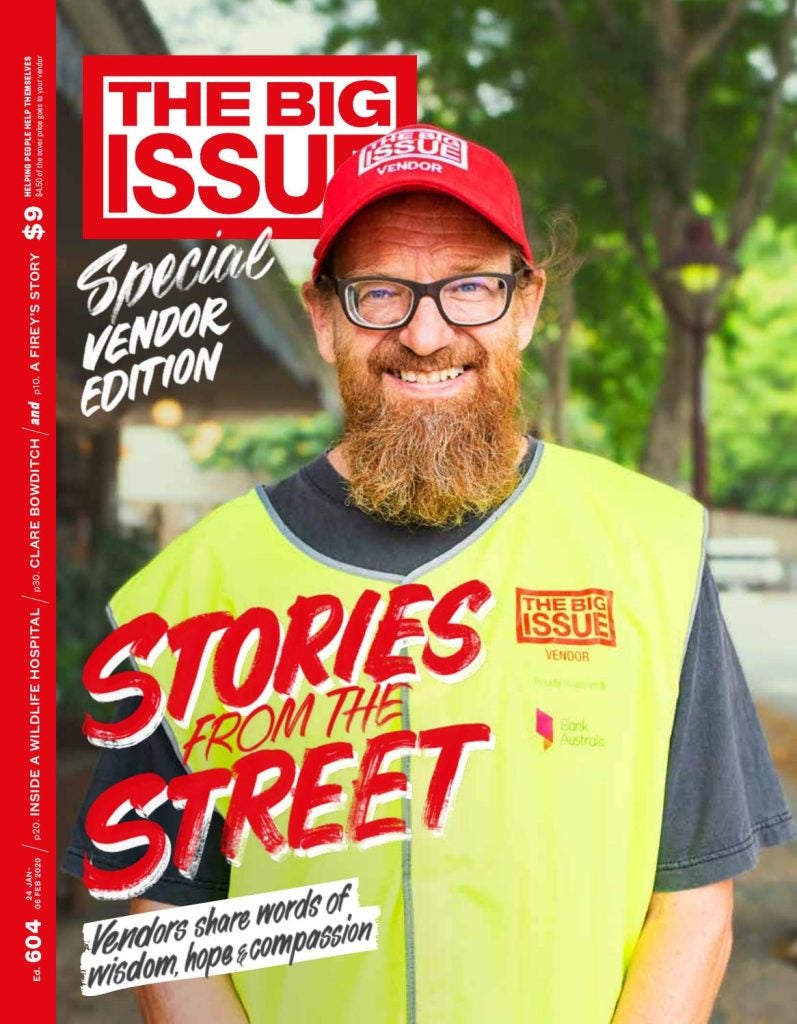
You first step foot into Australia, which is home to over 25 million people, yet over one hundred thousand remain unhoused. In the metropolitan city of Brisbane, almost ten thousand individuals suffer from housing insecurity. As you saunter down the streets of this Australian city, you run into Tony G, an active vendor for The Big Issue. Just like other vendors, he makes a substantial portion of his income selling each paper on the streets for $9.00 after buying his stock for $4.50, allowing him to make a significant profit.
Inspired by the successful United Kingdom Big Issue, Australia’s edition was created in the early 1990s in order to address this growing problem all over the country. Today, The Big Issue is a macroscale organization, with the street paper serving as a major facet alongside other sub-programs such as the Women’s Workforce, The Big Issue Classroom, and the Community Street Soccer Program. The overall mission of this paper is to explore ways in which these programs can be utilized in order to mitigate homelessness, marginalization, and disadvantage through creating work opportunities wherever possible. In the words of The Big Issue, “we help people help themselves.”
DESTINATION #2: CANADA
You now find yourself in Alberta, Canada, a semi-urban province that has a population of just under 4.5 million people, with almost 6,000 individuals experiencing homelessness. You step out and begin walking through the snowy streets of Morinville (a small town in the Edmonton Metropolitan Region of Alberta), the frigid air slicing at your exposed face. Just outside the warm haven of a coffee shop, you meet John Zapantis, a vendor for Alberta Street News.
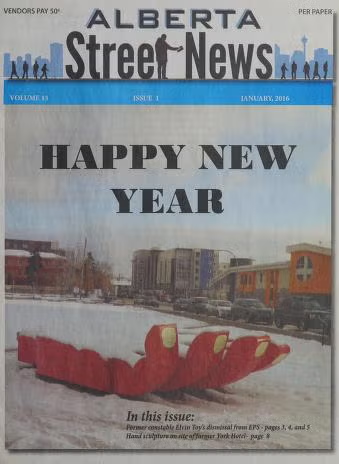
John is a seasoned vendor, and has not only sold hundreds of copies, but writes and edits for the paper as well. John, and all the other vendors, are given the opportunity to truly be in charge of their micro-business. They buy their copies of the paper at fifty cents each, and sell them to the public for whatever amount they see reasonable. The price they sell them at greatly depends on the demand in the area of Alberta they are in, which is usually Calgary or Edmonton.
This street paper was originally created in 2003 by Linda Dumont, the founder, editor, and designer. Unlike the The Big Issue, Alberta Street News is only a street paper and not a more prominent organization with multiple components. Their main goal is to provide an avenue for vendors who face barriers of all types to improve their quality of life.
DESTINATION #3: USA
You are met with the buzz of cars zipping by and the chatter of scurrying crowds trying to escape the rain as you enter Seattle, Washington. This very urban city has a population of almost 800,000 people, but close to 12,000 are without a home.
As you walk down the street, you hear a warm, effervescent voice call out to you. A very hospitable appearing woman approaches you, with stacks of papers in her hand. She tells you her name is Sharon Sherpa, and that she is a vendor for Real Change News. She sells the paper for $2.00, after purchasing her own copies for sixty cents.
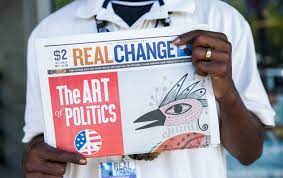
Real Change News was created in 1994 in order to combat the homelessness epidemic. Similar to Alberta Street News, this newspaper is just that: a newspaper, with the only exception being their volunteer program. Their overall mission is to foster an inclusive community where the marginalization of individuals is mitigated. They believe that everyone is entitled to live a life with dignity.
In your hands, you now hold three editions of three street papers.
OBSERVATION #1: CONTENT
You notice that although each paper aims to attenuate the effects of poverty and homelessness, each boasts a spectrum of content for its readers.
Despite most street papers being written about social justice matters, The Big Issue caters to a wider audience with not only including commentary on social issues, but also vendors’ stories, popular culture, and celebrity profiles. Essentially, this paper covers almost all public interest bases, which attracts a wide range of people. Even more so, their paper is structured more as a magazine, which allows it to stand out from other street newspapers.
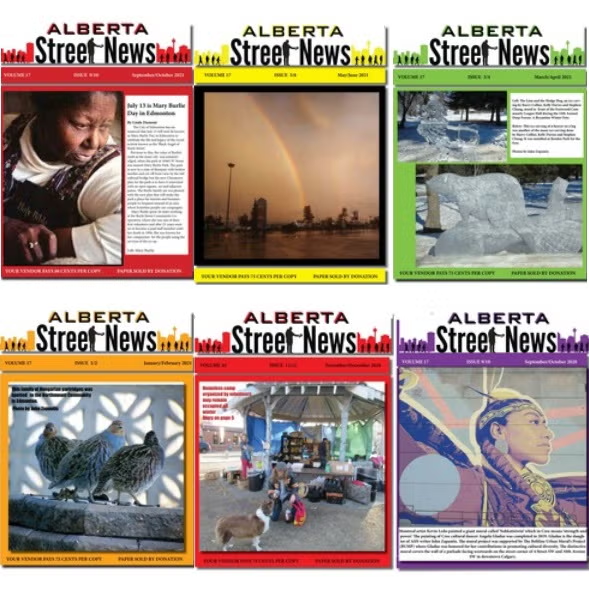
Alberta Street News contains mostly stories from the perspectives of homeless people or social justice, a major difference between this paper and The Big Issue. Your edition, from September 2022, contains more serious content such as advice columns about how to prepare for the cold winter months and current issues regarding Pope Francis and Indigenous people. There are also the occasional lighthearted pieces such as poetry and a ‘Halloween Survival Guide’. Nonetheless, this paper is mostly about social matters, which may hinder its ability to reach wider audiences like The Big Issue can, as not all people like reading about social justice matters on a daily basis.
Yet, Alberta Street News may be arguably more meaningful in terms of content because they also allow vendors, such as John Zapantis, to write for them. This allows for their usually silenced voices to be heard. Therefore, The Big Issue may be seen as more commercial, due to the fact that their content is written only by a professional team, and vendors only sell the paper.
Real Change News takes an approach very similar to that of Alberta Street News, in that most of its content is social justice related. However, the overall paper resembles more of a local commercial newspaper because many of the topics that are written are about Seattle events specifically, with the occasional articles on COVID-19 and politics.
In your issue, from the first week of September, some topics include the Seattle mayor’s comments on homelessness, a strike led by Members of the Seattle Education Association (SEA), and a skateboard contest for women and transgender competitors called ‘Wheels of Fortune’. You flip to the back and even find a crossword puzzle.
Each paper also publishes their issue at different intervals. The Big Issue releases new editions every two weeks, while Alberta Street News does so only six times a year (about every two months), and Real Change News publishes every week.
Overall, each paper has content that has a different impact on the readers. But more importantly, all address important societal issues to initiate systemic change.
OBSERVATION #2: ONLINE PRESENCE
As you become increasingly curious about each of the different papers, you decide to visit their websites.
The Big Issue’s website presents a very dynamic and interactive interface. It has clearly labeled tabs that allow you to navigate various information. On this website, the history of the paper, the various programs, and subscription services are readily available. In fact, the subscription service actually involves receiving a physical copy of the magazine, and this has created another opportunity for employment. Specifically, through the Women’s Workforce program, hundreds of women who experienced domestic violence and who were often forced to the streets are paid to package purchased online subscriptions. Evidently, The Big Issue excels in creating multiple opportunities through various avenues.
However, the website might be too simplistic, regardless of the ease of use. There are not many stories focused on the vendors themselves, and since the overall goal of this paper is to serve them, it might be more effective to relay the narratives of each of the vendors. You have already met Tony G, who told you about his dedication to The Big Issue. He has amassed over 20 years of experience selling the paper. He even told you about his Bull Arab dog, Pinky, whom he says is his best friend.
You wonder about the untold stories of the hundreds of other vendors.
Alberta Street News’ website is quite simple, but provides a lot of information. Similar to The Big Issue, this website has easy access to its history, mission, and prior issues. One of the biggest differences, however, is that its past issues are not subscription based, like The Big Issue. All of the published issues are found under the ‘Archive’ tab and are readily available to the public.
Even though this means that vendors make their money through this paper primarily in person and the public does not necessarily have to buy the paper in order to read it, providing the paper for free online effectively promotes awareness on present social issues. Moreover, providing the paper for free captures the true essence of what Alberta Street News stands for: providing a voice for the under-privileged.

The website of Real Change News is the best combination of aspects from The Big Issue and Alberta Street News. This website presents a very elegant, yet illuminating user interface. Just like The Big Issue, there are simple tabs that give information on history and ways to get involved. But Real Change News takes it one step further; each tab has subtabs that provide relevant details. For instance, the ‘advocacy’ tab has two subgroups (‘Lived Experience Speakers Bureau’ & ‘Take Action’) that let the reader know about specific events that are occurring as well as ways they can get involved. Another subtab has links to hundreds of vendor narratives, which The Big Issue and Alberta Street News lack. This allows for Real Change News to be an enriching read.
One prominent difference between the website version of this paper is that the articles can be viewed through a series of links instead of a single online document containing all the stories. This is where the website falls short in terms of design compared to the other two websites, since having the exact online replica of the paper version might be more aesthetically pleasing to the majority. Yet, the stories are still conveyed and the impact is felt by the vendors.
Although each paper is available both online and in person, each avenue results in benefits and drawbacks for not only vendors, but for consumers as well. The modern, adaptive online interface allows users to purchase any of the previous issues of the paper and also provides opportunities for them to get involved, which may not be possible if the paper is merely sold in person. Contrary to the online sales, in-person sales allow the vendors to connect with the locals on a more personal level, allowing them to form a sense of community that they often lack.
Tony told you that he has gotten to “know so many beautiful people out there over the years.” Evidently, this human connection is pivotal to many vendors, and it is an element that the online platform can and may never be able to provide.
OBSERVATION #3: COMMUNITY AND IMPACT
You recall how thankful each of the vendors you met were; despite their situation, they were very grateful to be working for their respective papers. They were especially thankful for the community they were able to form through the paper.
Tony G likes working on his own terms and running his own micro business. The Big Issue has allowed him to become one of the biggest vendors in Queensland. He especially values the variety of individuals he has met over the years and enjoys watching people laugh. According to Tony, “I don’t judge people: no matter who they are, whether they are in a uniform or casual, I give them a show.”
For John Zapantis, Alberta Street News was one of the ways he was able to rekindle his love for writing. Through the community he has built, he has become not only a writer for the paper, but also a photographer and media spokesperson. He says, “that’s why I’m here to involve everyone in the process, and that’s why I’m here to make the corner of 100 Street and 100 Avenue my home to promote this cause while involving everyone in the process.”

Sharon Sherpa had a rather unique experience with building a community through Real Change News. Originally from Nepal, she has lived in Tokyo, San Francisco, and Portland. She is a multilingual woman of color that suffers from housing security and medical issues. Despite the racism and misogyny she encounters, Sharon is extremely thankful to be able to interact with so many diverse people. She says, “I feel blessed. Now, a lot of my real family is here, and I have garnered a lot of good American friends. To have somebody by your side is very important.”
The impact of these papers reaches beyond their local communities as well. Through social media, each paper has also been able to garner followers, thus creating an online community to benefit vendors.
The Big Issue has a substantial social media presence, with regular posts on Instagram, Facebook, and Twitter, while Alberta Street News is only active on Twitter and Facebook. Real Change News is the most active out of the three, with accounts on Twitter, Facebook, Instagram, YouTube, and even LinkedIn. A community built on social media can be especially relevant for younger generations who may prefer virtual content.
Ultimately, being active on social media allows each paper to not only reach a local audience, but a global one as well.
THE FINAL DESTINATION
You walk down the streets of an urban city, the buildings towering over, the narrow alleyways stretching endlessly in every direction. The hundreds of people bustling around you are engrossed in their own busy lives, paying you no attention. You see several people squatting on crates on the side of the street, cups half filled with dollar bills and loose change. You notice one of them holding a big stack of newspapers. You enthusiastically approach him, with a big smile across your face. You side-step around people passing by. You have finally reached him.
“What’s in this week’s issue?” you ask.
“Buy a copy and find out!” he excitedly responds.
He hands you the paper, as you reach into your pocket to pay him. He thanks you, a genuine smile appearing across his face. You smile back, as you begin to flip through the street paper, eagerly awaiting to read the narratives of the forgotten.
Works Cited
“Alberta Street News.” Alberta Street News, http://www.albertastreetnews.org/.
“Alberta Street News: September/October 2022.” Alberta Street News, http://www.albertastreetnews.org/archive-2022/.
“Alberta Street News, Volume 13, Issue 1, 2016 : Free Download, Borrow, and Streaming.” Internet Archive, 1 Jan. 2016, https://archive.org/details/asn20161301.
Dafoe, Stephen. “Writer Takes It to the Streets.” Morinville News – Morinville Online, 26 Sept. 2012, https://morinvillenews.com/2012/09/25/writer-takes-it-to-the-streets/.
“Homelessness in Seattle.” Wikipedia, Wikimedia Foundation, 8 Oct. 2022, https://en.wikipedia.org/wiki/Homelessness_in_Seattle.
“Real Change News.” Real Change News, https://www.realchangenews.org/.
Schear, Jacob. “Vendor Sharon Sherpa on Making Connections: ‘the Best Words to Say in Any Culture Are ‘Thank You.”‘.” Jun 1-7, 2022 | Real Change, Real Change, 1 June 2022, https://www.realchangenews.org/news/2022/06/01/vendor-sharon-sherpa-making-connections-best-words-say-any-culture-are-thank-you.
The Big Issue Australia Follow this publisher – current follower count:60. “The Big Issue Australia #604 – Vendor Week.” Issuu, 24 Jan. 2020, https://issuu.com/thebigissueaustralia/docs/the_big_issue_edition_604.
“The Big Issue Australia.” The Big Issue, https://thebigissue.org.au/.
“Tony G.” The Big Issue, 30 Sept. 2022, https://thebigissue.org.au/vendor/tony-g/.
Zheng, written by Emily. “Digitization Spotlight: Alberta Street News.” News.library.ualberta.ca, 1 Mar. 2022, https://news.library.ualberta.ca/blog/2022/03/02/digitization-spotlight-alberta-street-news/.