Picture this: You’re sitting on your favorite corner during rush hour, contemplating when your next meal will be, surrounded by hundreds of individuals as they pass you by headed in every direction, yet none care to give a glimpse towards you. The issues that pertain to your everyday life are shared on social media, the news, and in the papers under the heading “hot button topic”, but when you speak on the matter from your perspective, people either tend to disregard it, or look at you with shame like a piece of garbage. Being treated as an anomaly can be disheartening, and alas, the homeless community endures this treatment daily. Even when an opportunity presents itself, most of the homeless are overlooked.

An opportunity for the homeless
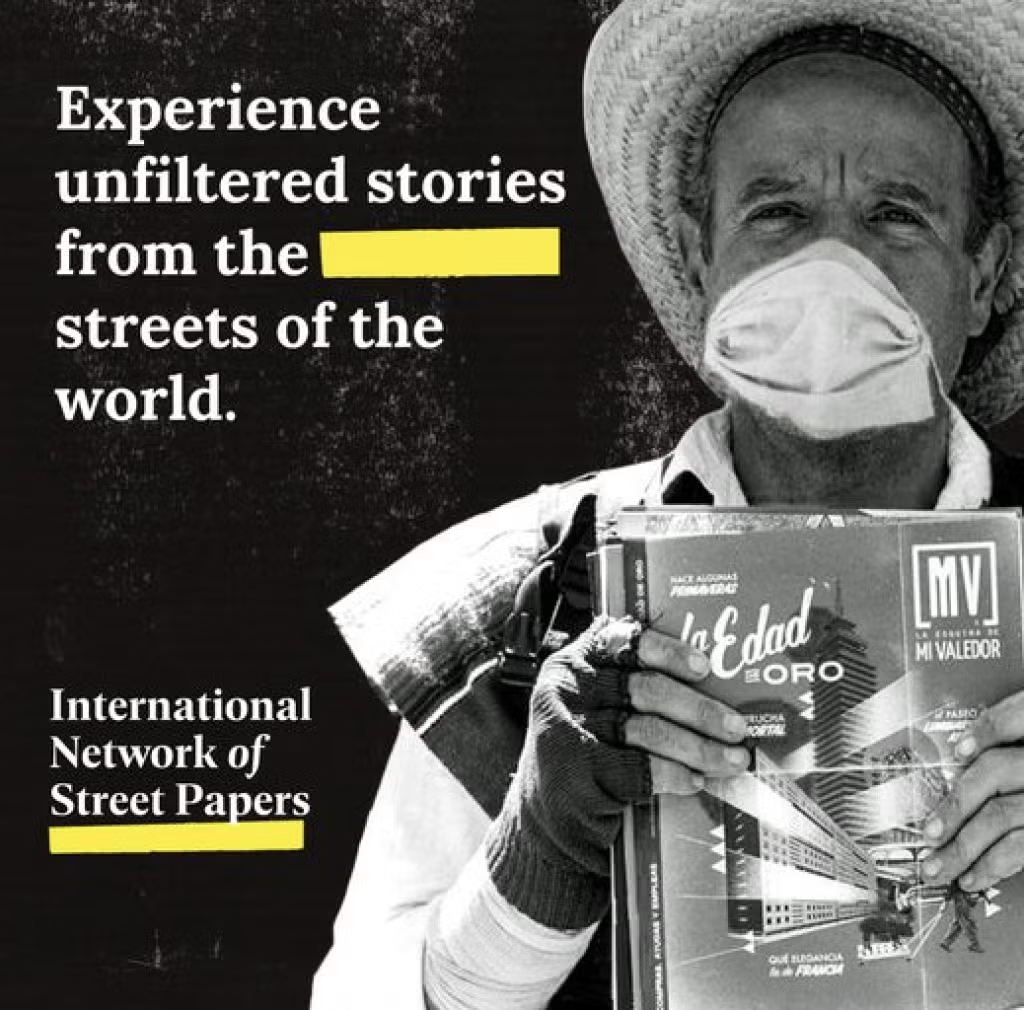
Fortunately, the International Network of Street Paper (INSP) provides a rare yet valuable opportunity to the homeless. The INSP fights poverty and homelessness by having homeless people write, edit and sell newspapers. The homeless can finally vocalize their concerns, experiences, and life lessons all while allowing them to rebuild themselves. INSP highlights various street papers from all over the world on their website, https://www.insp.ngo, three of which we will dissect in this article and relate to their prospective communities.
What is a street paper?
Street papers are newspapers sold by vendors that are typically made up of homeless or poorer individuals. Most street papers are primarily issued to cover ground on homelessness and poverty-related issues, and aim to strengthen the network of their vendors to the communities surrounding them. Street papers also provide the local homeless opportunities to work or share their stories, most of which are shared in the papers and written by those they try to help.
How do we define a community?
Traditionally, a community is set by a social group of members who share a local environment, government, and cultural or historical values or heritage. In terms of how we define the homeless community, it is a group shaped of low-income individuals without an environment that is considered their’s, therefore they come together with other local individuals that are either in the same position or would like to help lift one another up.
Our chosen papers on how they shape their communities
Today, we are going to examine three different street papers and how they shape their communities. These street papers were picked due to their heavy homeless population and the range of their political views. Topics such as existing concerns for the community that the paper has, the attitude the paper has in response to these concerns and the paper’s mission statement will all be discussed. The community addressed in this paper would be anyone that is involved with these street papers. Of course, everything has its positives and negatives. These street papers are no exception and their negatives will be explored.
StreetWise Chicago, Illinois

The first street paper we will take a look at is StreetWise. StreetWise is a street paper founded in 1992 based in Chicago. Around 65 thousand people experienced homelessness in 2020, a seven thousand person increase just from the previous year. StreetWise provides the opportunity for those who are struggling to become vendors. They buy newspapers and re-sell them for a small profit. It gives the people in need a chance to become micro-entrepreneurs.
StreetWise also provides essentials to all seeking a job. If you are actively in search of a job, they will provide free grab and go meals, essential hygiene products, and so much more. StreetWise is not only committed to the homeless community as their care goes beyond and reaches out to those who are veterans, disability recipients, and justice served individuals. One of the few things that separate StreetWise from the other street papers is their S.T.E.P program. This program prepares the homeless to work a full time job, not just presenting the opportunity to be a news vendor. One of the most unique things about StreetWise is they make their vendors known. On their website they have a section to meet their vendors. They have pictures and locations where you can meet them. This shows how truly prominent StreetWise is in making sure that the homeless community is seen. Something surprising that you can find on their website is a podcast that brings their vendors on as guests. Not only do they ensure that their vendors are seen, but also heard. It is clear that their commitment to the community and making sure their vendors feel valued is their mission statement. Step by step, pun intended, StreetWise is helping reshape their community in Chicago.
Street Sense Media Washington, D.C.
The next street paper we will be examining is Street Sense Media based in Washington D.C. In D.C. alone there are about 4,000 homeless individuals. Street Sense Media was started in early 2003 when two volunteers approached the National coalition for the homeless. Street Sense produces theater, journalism, film, photography and much more. These projects are all done within the homeless community. The content of the media they produce is focused on challenging the perception of the homeless. Street Sense Media believes that this creates a common ground between the homeless and the community that they are a part of. It shows that the homeless can be creative and are just like any other person.

They believe that although economic opportunity does not always get distributed evenly, talent is. It is clear that Street Sense Media is trying to build a strong community in D.C. Their mission of empowering people in need by utilizing their skills beyond newspapers is a clear representation of trying to pull the community together. However, the picture that Street Sense Media portrays is that the homeless community is well heard and well appreciated in D.C. This is not the case. The rise of drug use in the district has caused an increase in the homeless population. The district is not fighting a homeless population problem, they are fighting an increasing homeless population problem. As of now the district is mostly concerned with the unhoused seniors problem, leading to others being left out of government aid. Another problem the district is facing is the health care of the unhoused. Nearby hospitals are seeing an increase in heart disease, cancer, and overdose for those unhoused. This leads to them receiving less funds to help their housing problem as most are spent on their health care. Street Sense Media has had the same homeless people work with them for over 20 years. While that might sound great, they have not really taken any action steps to help build and prepare these homeless people on their own. With all that being said, the work of Street Sense Media is undoubtedly honest and provides a small opportunity for the homeless community to be heard. However, they do not go above and beyond in trying to find permanent homes for its community.
Thrive Detroit Detroit, Michigan

The last street paper of our investigation is Thrive Detroit. Thrive is based in Detroit, where the city has a population of 2,000 people that are homeless. When it comes to Detroit, the homeless population has gotten far smaller than what it previously used to be. In 2010, the homeless population in Detroit was around twenty thousand people. By far the highest population out of all the cities we have examined today. We can see that Detroit has been combating its homeless population problem, but exactly how much was due to the Thrive street paper? Thrive first launched in 2011 when the homeless population was the highest in Detroit. Its mission, like others, was to help shelterless people get back on their feet. They provide vendors with ten issues of their newspaper for no charge. Vendors are then able to sell the paper at a small profit, micro-entrepreneur style. Thrive has a unique feature in which vendors are allowed to sell ad space on the paper. The vendor receives 30 percent of all ad revenue generated by the printing space they have sold. Furthermore, vendors that sell over a hundred papers receive their own ID badges and identifying vest. This can bring a sense of security for many homeless people. To see yourself wearing a badge and a uniform while earning an income can help an individual regain the much needed confidence to build themselves. They are seeing first hand that they can handle a job. It expands their horizons and pushes them that extra bit to seek full time employment. Additionally, Thrive offers money management classes, courses in sales, and writing workshops. They believe that educating their people is the main factor in helping them recover financial stability. Since the start of Thrive, Detroit’s homeless population has been on a decline. It is clear that Thrive’s mission is not to only help the homeless community, but rather to help the city itself as a whole. Of course, government agencies have also contributed to these numbers, however, the impact that Thrive has had on the homeless community in Detroit cannot go unappreciated.
How do these papers relate (or not) to each other?
Now that we have explored the background of some of the street papers that are a part of the INSP, we are going to look at the similarities and differences on how these street papers operate.
StreetWise vs Street Sense Media on the treatment of their earners

When looking at StreetWise, it is apparent that their core values are different from Street Sense Media. StreetWise helps the homeless community engage back into the world on a personal level. On their website, they have a section where all their vendors are identified. This helps to get the homeless community to be seen. It brings back the confidence of many vendors as they have mentioned in their statements. This will also help desensitize other people from the negative stigma that surrounds the homeless community.
It brings the realization that these are people just like us just with unfortunate circumstances. Street Sense Media does not go much into detail about their vendors. In fact, no specific vendors are even mentioned on their site. It is clear that Street Sense Media is more focused on providing financial necessity more than having the people be heard. Now of course they have people write in the paper, but they do not take the extra step to establish that connection between the homeless and the community they live around. Although Street Sense Media does not focus on connecting the homeless with the community, they focus on bringing the many talents these people have to life. Their programs offer a variety of ways to display these talents.
The endless options from journalism, to theater, to film and many more ensures that everyone gets a fair chance to show off their talent and hard work. This in a way will help bring the homeless and the community it is around closer to each other. StreetWise also offers essential help to all their vendors. They provide meals, hygiene products and many other necessities to all their regular vendors unlike Street Sense Media. Although these two street papers have a different approach in helping the homeless community, they serve the same purpose. Their hard work has helped many take their first in financial recovery.

StreetWise vs Thrive Detroit on resources provided to the community
The next two street papers that we are going to compare are StreetWise and Thrive Detroit. Both Thrive and StreetWise operate in similar ways. Just like StreetWise, Thrive focuses on humanizing the homeless community. Similar to the StreetWise website, Thrive has a blog section on their website.

Here, people from the homeless community can share updates about their journey. This helps the people to see the homeless community as if their next door neighbor is sharing an update on social media. Unlike StreetWise, Thrive does not offer emergency help such as grab and go meals and hygiene products.
Another similarity that these two papers share is the programs they offer to people. Thrive offers money management classes, sales classes and writing workshops to help people secure financial stability. StreetWise has their S.T.E.P program in which they also help people achieve financial security. One of the differences that I found to be very interesting is that Thrive offers ten copies of their newspaper to first time vendors for free. An individual can have absolutely nothing and slowly begin to build themselves up, dollar by dollar. Although StreetWise offers their papers at a very cheap price, you would still have to have something to start. One of the main reasons I believe that these two street papers share the goal of humanizing the homeless is due to the fact that they are very close to each other in terms of geographical locations. The midwest region of the country seems to look at the homeless community as complete outsiders, turning their heads away rather than offering their hand to help. Both of these street papers have helped bring a new perspective on the homeless community. Their work has not gone unnoticed as the homeless population has decreased in both Chicago and Detroit from a decade ago.
Thrive Detroit vs Street Sense Media on community development
Lastly, we will be comparing Street Sense Media and Thrive. One of the main differences between these two street papers is that Street Sense Media started their program much later than Thrive Detroit did. The Street Sense Media vendor program only began in 2017 compared to Thrive which started in 2011. The effects of Street Sense Media vendor programs have not been shown completely unlike Thrive. Thrive has had the time to develop and establish themselves as one of the main reasons the number of homeless population has decreased in the city of Detroit, while Street Sense Media has not.

This does not go to say that Street Sense Media is not helpful, they simply have not had enough time to see the full results of the change they can bring. Street Sense Media has a similar approach in helping the homeless reach their financial goals. Both street papers believe that educating and guiding the homeless is the main way of combating the issue. They offer the right resources such as case management and outreach, workshops and much more. Unlike Thrive, Street Sense Media does not get personal on their website. There are no sections in which the vendors are identified or get to simply write and share updates on their journey. This could be due to the fact that homeless people are looked at with more empathy in D.C when compared to Detroit. Although these two papers have different approaches and views when it comes to their homeless communities, they both provide an opportunity to people in need. They also both try to set up their vendors to long term success and not just a quick cash grab. With the Street Sense Media vendor program being very new, I look forward to seeing if they will adapt some of the strategies that Thrive utilized in ensuring the homeless population decreases and gets the proper help that it needs.
Work Cited
Annemarie Cuccia // September 7, 2022, et al. “Street Sense Media.” Street Sense Media, https://www.streetsensemedia.org/.
Barnes, Elvert. “02A.StreetSense.18K.NW.WDC.31January2012.” Flickr, Yahoo!, 2 Feb. 2012, https://www.flickr.com/photos/perspective/6805189437/in/photolist-RuRwAM-9xtBSJ-ia6BSq-ia6ozK-2iaGS14-VezsaC-bwPN8m-rNTCrm-DEwize-aZtPLK-ebqEqj-gucYpD-5Y9bis-23o9TqC-8doRo1-BzvAKS-d1xbAL-fzNvo4-e4fhAa-mXgD3F-e4najd-bg1YqX-6dCZhb-e4gxFH-ia42Mq-fsm8W7-qUdp8-5Spis2-bcNvLD-4G6PCH-W3GF2-vXu8rR-5TViE4-6bLBXf-7Z1yxv-bDPUDZ-76bCBJ-7B9PRR-3d3HPg-9DyA3R-3d3HQR-bvwDLV-bnmnJn-8XJ2fH-87Xbvh-5neVET-3d3HJR-9tfr6x-ovSprh-6hqVq6.
Fields, Samantha. “As Homelessness Rises, Some States Make It Illegal to Sleep Outside .” Marketplace, 11 Aug. 2022, https://www.marketplace.org/2022/08/11/as-homelessness-rises-some-states-make-it-illegal-to-sleep-outside/.
“Homelessness in the United States by State.” Wikipedia, Wikimedia Foundation, 6 Sept. 2022, https://en.wikipedia.org/wiki/Homelessness_in_the_United_States_by_state.
“INSP.” Facebook, https://www.facebook.com/inspstreetpapers/.
Levine, Jon, and Mary Kay Linge. “Squad Members Turn Capitol Hill into Homeless Encampment.” New York Post, New York Post, 1 Aug. 2021, https://nypost.com/2021/07/31/squad-members-turns-capitol-hill-into-encampment/.
“Street Newspaper.” Wikipedia, Wikimedia Foundation, 30 Aug. 2022, https://en.wikipedia.org/wiki/Street_newspaper.
“Streetwise Chicago, Publication Helping Homeless, Celebrates 30th Anniversary.” ABC7 Chicago, 24 Aug. 2022, https://abc7chicago.com/streetwise-chicago-homeless-panhandling/12162304/.
“Streetwise.” StreetWise, https://www.streetwise.org/.
“Thrive Detroit – Home.” Thrive Detroit, 28 Sept. 1970, https://www.thrivedetroit.org/.
“To Keep Distributors Safe, Street Sense Is Suspending Its Print Publication.” DCist, 27 Mar. 2020, https://dcist.com/story/20/03/27/to-keep-distributors-safe-street-sense-is-suspending-its-print-publication/.
Williams, Candice. “Covid-19 Challenges Social Service Agencies Serving Detroit Homeless.” The Detroit News, The Detroit News, 15 Apr. 2020, https://www.detroitnews.com/story/news/local/michigan/2020/04/14/covid-19-challenges-agencies-serving-detroit-homeless/2965764001/.