What are Street Papers?
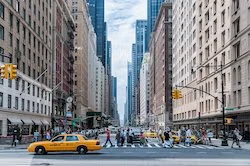
Street Paper : “Street papers are magazines or newspapers sold by people experiencing poverty, homelessness or other forms of marginalisation.”
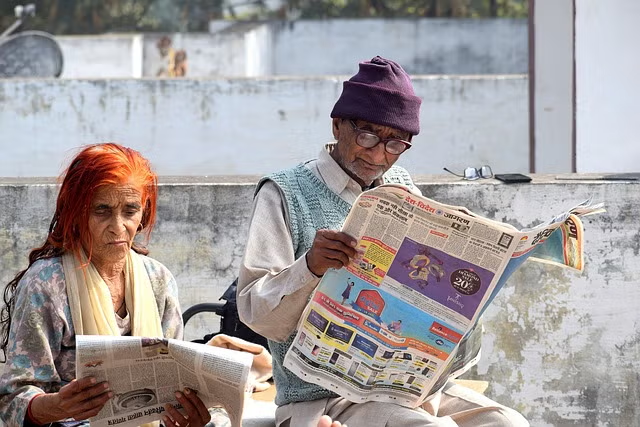
While street papers may be a foreign or unknown concept to some, their presence amongst urban communities is felt all around the world. Street Papers are local, nonprofit, organizations that produce digital and printed media content — such as newspapers and literary magazines — to support those experiencing financial and housing instability in their community. Organizations hire vendors seeking financial support and give them their latest edition to sell and then profit from, allowing many to generate much-needed income.
Image: Balouria Rajesh, Pixabay
“They give people an immediate, dignified and legitimate way to earn money whilst seeking to address the causes of poverty through journalism and advocacy.”
The International Network of Street Papers

The INSP, or the International Network of Street Papers, is an organization that works to support street papers across the globe. They choose to fight homelessness by raising awareness through literary and journalistic efforts.
The following street papers are displayed on the INSP website. If you want explore different street papers around the world, visit INPS’ “Find a Street Paper” search engine.
Image: INSP logo
Community


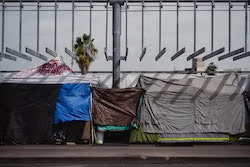
Definition:
1: a unified body of individuals: such as
a: the people with common interests living in a particular area
broadly : the area itself.
b: a group of people with a common characteristic or interest living together within a larger society.
As defined by the Merriam-Webster Dictionary, “community” is a universal term used to describe a group of people who share a commonality, whether that be location, status, interest, or characteristics. In this article, I will use the term “community” to refer to locally housed residents and the local homeless population.
Get to Know the Papers!

Street Sheet, StreetWise, and Street Sense Media represent urban, homeless communities across the nation — spanning from the west to east coasts. While these three organizations reside in differing environments, there are still similarities to be found amongst their distinctions.
Street Sheet

Street Sheet was founded in San Francisco, California, as a publication for the Coalition of Homelessness — first established in 1987. Street Sheet values literary creativity and utilizes the power of writing to help change poverty narratives and support the local homeless community.
Their content production ranges from news articles and creative writing to artwork and photography. Each category is showcased in Street Sheet’s printed issues. News articles and other written content may also be displayed on their website, along with the PDF version of printed issues.
Registered vendors are permitted up to 100 copies of the latest issue Monday through Friday and are expected to sell each paper at a price of $2.00. Street Sheet vendors are not required to buy the papers they sell, and they keep 100% of the profits earned during distribution. The Coalition of Homelessness also offers peer support, leadership development, and public education initiatives to help combat homelessness.
Image: Street Sheet, August 15th Issue – Cover Image
StreetWise

StreetWise is a street paper organization in Chicago, Illinois. Founded by Judd Lofchie, the first edition of StreetWise debuted August 24th, 1992. In March 2020, StreetWise was included in YWCA Metropolitan Chicago portfolio of comprehensive human services. They also maintain memberships in the International Network of Street Papers and The Chicago Independence Media Alliance.
StreetWise produces a variety of content including written articles, artistic work, and podcast episodes. Vendors buy a magazine for $1.15 and sell it for $3.00, earning a profit of $1.85 per magazine. Vendors may also keep 100% of tips they receive.
The StreetWise organization has employment programs to help those struggling with housing insecurity and unemployment. S.T.E.P into Employment works to help individuals overcome barriers by offering resume & interview workshops, job coaching, transportation and uniform subsidies, and professional development advisement. This program is partially funded by the City of Chicago Department of Family & Support Services.
Image: StreetWise, Indigenous Peoples Day Edition – Cover Image
Street Sense Media
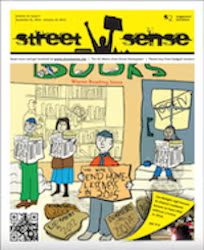
Washington D.C. — capital of the United States — is home to the street paper organization, Street Sense Media. Street Sense published their first article in November of 2003. Community volunteers, Laura Thompson-Osuri and Ted Henson, were the first to request a street paper organization in D.C. through the National Coalition for the Homeless. Street Sense Media joined the Institute for Nonprofit News in 2020. Presently, Street Sense is the only paper in Washington D.C. dedicated to supporting the homeless community and combating poverty.
Street Sense Media produces a wide range of multimodal content such as film, illustration, photography, podcast, and theater. Each of these content categories offer abundant opportunities for community involvement and productive, creative expression.
Street Sense Media vendors are provided with free issues. They sell the papers for $2.00 each, receiving 100% of the profits from their distribution efforts. Additionally, Street Sense founded a Case Management Services program in 2017. This initiative guides long-term vendors through legal barriers and issues relevant in obtaining housing, employment, and healthcare.
Image: Street Sense Media, Volume 12 Issue 4, Cover Image
Content & Operations Comparisons
While Street Sheet, StreetWise, and Street Sense Media follow the same overarching guidelines, each organization has important similarities and distinctions within their content production, vendor programs, and community outreach initiatives.
Street Sheet, for example, uses their website to highlight journalistic content rather than creative. Their other sections’ work can be found on the full-issue PDFs uploaded under their “about” tab. Choosing to only include news articles on their homepage may be a strategic decision — by not making their creative content readily available on their website, interested readers are more inclined to buy a physical paper from a vendor. The reporting articles featured on Street Sheet’s home page reflect issues within the homeless community along with relevant events occurring within San Francisco. It is clear that matters impacting their vendors and the homeless community are Street Sheet’s primary concern.
Likewise, StreetWise, chooses only to feature their recent news articles and podcast episodes on their website, rather than other creative content. However, while there are articles relevant to the homeless community, StreetWise‘s recent editions thematically report on interesting characters, influential people, and city-wide events in the Chicago area. Full-issue PDFs do not appear available on their website — supporting the organization’s desire for readers to buy physical copies from vendors, rather than read it for free online.
Additionally, Street Sense Media provides the most content on their website. While they choose to highlight news articles and journalistic content on their homepage, they have a tab to showcase all work. Not only do they provide the typical article sections like news, opinion, and art, but they also produce content for different media channels, e.g. film, podcast, illustration, theater, and photography. Like Street Sheet, Street Sense Media also provides PDF downloads of their printed issues. By consistently reporting on events and policies that impact those experiencing housing instability, it is clear that Street Sense Media’s main concern is for D.C.’s homeless community.
In comparison to Street Sheet and Street Sense Media, StreetWise places much more emphasis on income and donations. For example, StreetWise has not only a donate button on the home page, but also a tab where readers can buy a subscription and StreetWise merchandise. Such income-generating features are combined with the $1.15 StreetWise charges vendors to purchase each issue. Street Sheet and Street Sense Media provide vendors with free issues — generating more income than StreetWise vendors.
While StreetWise may request the most money from its audience and vendors, it is also the paper to provide the most employment coaching and job help amongst the three papers examined. Street Sheet and Street Sense Media provide advisement and charitable donations to their vendors and local homeless community, but they place more emphasis on literary initiatives, like writer’s groups and theater, rather than professional development programs.
Geographical Context
Street Sheet – San Francisco

San Francisco, Street Sheet’s metropolitan community, is the fourth most populated city in California and 17th most populated in the United States — home to 815,201 residents as of 2021. San Francisco is the second most educated city in the country with over 44% of adult residents possessing a bachelor’s degree or higher. The median household income in San Francisco is $65,519 with a median family income of $81,136.
Technological innovation and tourism are a driving elements in San Francisco’s economy. Silicon Valley, the tech center of the world, is located in the southern part of the San Francisco Bay Area. Additionally, given San Francisco’s frequent portrayal in media, film, and pop culture content, it’s landmarks are famous. The tourism industry occupies one in seven jobs in the city.
Homelessness and housing insecurity is a major issue in San Francisco. It has been at the center of many political debates in the past. According to The Office of the Mayor, San Francisco’s preliminary point-in-time (PIT) count for unhoused individuals in 2022 revealed that 7,754 people are currently experiencing homelessness within the city. While this is a very high quantity, the data shows that there was a 3.5% decrease in overall homelessness from 2019.
Street Sheet’s content reflects San Francisco’s large population of unhoused individuals. Articles like “A New Path to Reclaiming the Block,” “Fighting Drugs with Drugs: A Way Forward for San Francisco,” and “Right to Recover,” refer to issues facing the homeless community, supported by data from PTI counts. Street Sheet’s home page also features images of citizens protesting and information about the city’s work group meetings (Housing Justice Workgroup and Human Services Work Group), demonstrating how homelessness is a major political topic in the city.
However, one challenge facing the homeless community, which was not conveyed on The Mayor’s Office reports, is law enforcement. Police are disproportionately arresting homeless individuals and relocating tents by sweeping every so often. This is clearly a predominate issue in the area because it was featured in three of Street Sheet’s printed issues. Yet, such behavior is expected in areas that rely on the tourism industry for income.
StreetWise – Chicago
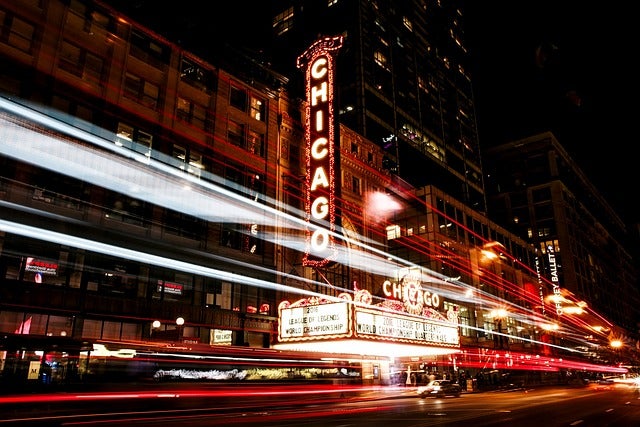
According to in the 2020 census, there are around 2,746,388 people residing in Chicago — making it the most populated city in Illinois and the third-most-populated city in the United States. The median household income is $62,097.
Chicago has a very strong economy. In 2020, Chicago’s gross metropolitan product (GMP) was $770.7 billion, the third largest output in the country, behind New York City and Los Angeles. The metropolitan area includes 36 Fortune 500 companies, and the city relies on facets like transportation, distribution, manufacturing, printing, publishing, insurance, entertainment, financial trading and services, and food processing to support its economy. The tourism industry also attributes a large portion of the city’s income to its restaurants, skyscrapers, museums and waterfronts.
According to the PIT count from the U.S. Department of Housing and Urban Development, 5,390 reported individuals were experiencing homelessness in 2020. Now, in 2022, that number is likely higher.
StreetWise’s content reflects the multifaceted elements of Chicago’s economy while also highlighting the current issues facing the homeless community. For example, news articles like “For “Chicago Fire” stylist Steykine Wills, the main job is about helping to build characters” and “Chicago Made brings film and TV production opportunities to residents,” highlights Chicago’s individuals and industries that are important to readers and creating new opportunities within the city. Additionally, podcast episodes like, “Episode 7: Bugs Between your Teeth” and “Episode 8: You’re SO Different,” tell the stories of various individuals and their experiences with homelessness. Due to the emphasis on economic success within Chicago, its fitting that StreetWise chooses to feature career paths in their content and promote their S.T.E.P into employment program.
Street Sense Media – Washington D.C.

Home to Street Sense Media, Washington D.C. is the capital city and federal district of the United States. Washington is estimated to have a population of 705,749 people residing in the city. However, the Washington D.C. Metropolitan Area (the city and its surrounding suburbs) ecompasses a much larger population of six million residents, making it the sixth largest metropolitan area in the U.S. While it is more common for families to live in neighboring suburbs, those residing in the city benefit from a median household income of $90,842.
D.C. thrives on a strong economy — earning the title of fourth largest metropolitan economy in the country. As expected, a large portion of jobs in Washington D.C are positions within the federal government. Aside from government careers, jobs within service organizations are common due the political environment of D.C. For example, the economy is largely supported by operations like civilian contractors, law firms, lobbying firms, trade unions, industry trade groups, and defense contractors. Nonprofit organizations, like Street Sense Media, are also very common due to the political nature of D.C. and frequent discussions about public policy. Because D.C. is the capital of the nation, museums and national landmarks generate tourist income that attributes to much of the economy’s success.
According to The National Alliance to End Homelessness, D.C.’s homeless population is around 6,380 individuals on any given night (the same survey logic as the PIT count).
While Street Sense Media‘s content reflects the political atmosphere of D.C., the organization chooses to emphasize the issues facing the homeless community rather than Washington’s role as the nation’s capital. However, Street Sense does produce content with D.C.’s relation to the federal government in mind. For example, articles like “It takes a whole village: ‘SHERO’ community walk celebrates community efforts to curb homelessness,” covers the importance and role of non-profit organizations in D.C. Additionally, current events in D.C. are already heavily covered by other journalists. Therefore, it is logical for Street Sense to use their platform to report on and advocate for those experiencing housing and financial insecurity within the community — a group that other organizations typically neglect.
Their Missions

Street Sheet, StreetWise, and Street Sense Media each have similar umbrella missions: support the local homeless community through voiced advocacy, vendor incomes, employment-relevant programs, and journalism. However, the strategy regarding the portrayal and display of each mission statement varies between papers — affecting every audience and community differently.
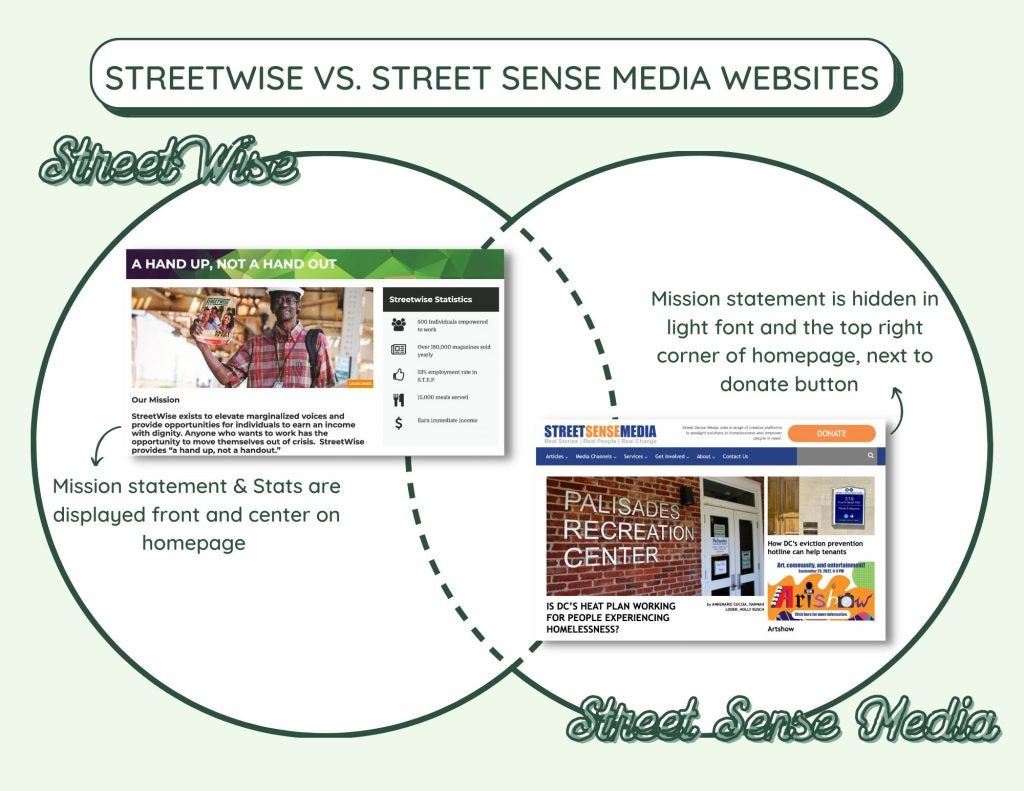
As demonstrated in the Venn diagram above, StreetWise and Street Sense Media’s website home pages utilize similar format elements, e.g., banner text, large image to the left, smaller media to the right, and text falling below. However, the organizations use very different approaches when displaying their mission statements on their home pages.
StreetWise’s mission statement is highlighted, front & center on their homepage. This positioning signals to readers that StreetWise’s initiative to help the homeless community is at the heart of their operation. Alternatively, Street Sense Media hides their mission statement in small, light font and the top right corner next to the donate button. This placement may appear as a “money grab” to readers.
Street Sheet’s Mission Display

Street Sheet has the most eye-catching display of their mission statement on their homepage. They use a rotating slide of four images, each accompanied by a different aspect of the mission and organization as a whole. This allows readers to understand the importance of Street Sheet on both a conceptual and literal plane. By using illustrations of writing and images of real people, the audience can feel more connected, and therefore, open to supporting Street Sheet’s purpose — either through donations, volunteering, or both.
A Message Behind the Message
StreetWise
“StreetWise exists to elevate marginalized voices and provide opportunities for individuals to earn an income with dignity. Anyone who wants to work has the opportunity to move themselves out of crisis. StreetWise provides “a hand up, not a handout.”
Streetwise Staff
Street Wise’s slogan is “A hand up, not a hand out” — choosing to emphasize the concept that “anyone who wants to work has the opportunity to move themselves out of crisis.” Such language endorses the “bootstraps narrative,” insinuating that all homeless individuals need is motivation and a hard working attitude to free themselves from poverty.
According to Andrew Volmert and Theresa L. Miller’s research in, Talking About Poverty: Narratives, Counter-Narratives, and Telling Effective Stories, the “Individual Drive Narrative” narrative is one of the most common stories about homelessness to frequent popular media.
“The most dominant narrative about poverty in the United States centers on individual willpower and drive. This narrative portrays individuals’ life outcomes as the direct and exclusive result of their choices and effort. According to this narrative, with enough hard work, anyone can and will succeed. In this narrative, individuals are in control of how well they do and thus responsible for their lot in life. People living in poverty are poor because of their own “bad” choices, lack of work ethic, and deficient values. They are blamed for their own situations and held responsible for getting themselves out of poverty.”
Volmert and Miller
StreetWise’s mission statement may support the “Bootstraps Version” of the “Individual Drive Narrative.”
“According to this variant of the narrative, it is up to individuals to metaphorically “pull themselves up by their own bootstraps” to get out of poverty…according to this narrative, individuals can overcome the odds and succeed if they have enough determination and grit.”
Volmert and Miller
While StreetWise’s mission statement may not explicitly say that homeless individuals can “claw” their way out of poverty through motivation alone, the sentiment of their mission statement certainly supports the “individual drive” and “bootstraps” narratives described by Miller and Volmert through word choice and tone.
Not only is the promotion of such prejudices on a street paper’s website ironic (street paper organizations typically work to fight assumptions about homelessness and poverty), but it is also harmful to housed-people’s perception of homeless individuals in the Chicago area. StreetWise’s participation in such narratives may negatively affect the mental health of individuals experiencing financial insecurity and divide the community’s economic classes. This may, in-turn, harm vendor’s profits because pedestrians may feel less inclined to donate.
Street Sheet & Street Sense Media
The infographic below demonstrates the contrast between StreetWise’s mission statement and those belonging to Street Sheet and Street Sense Media.

“About” Pages
Aside from the initial mission-statement introduction on the website home pages, Street Sheet, StreetWise, and Street Sense Media each have an “about” tab that provides the reader with more information about their background, operation procedures, alternate programs, staff, and relevant statistics. Not only is this a positive element of each website, but it is necessary for each street paper’s public credibility. Readers are more likely to donate and volunteer when they feel as though they can trust the organization — typically through the sharing of information, details, and references.
Concerns & Engagement
Although each community faces their own challenges, Street Sheet, StreetWise, and Street Sense Media each use the art of journalism and their vendor programs to help support those experiencing homelessness across the nation — working together to eradicate homelessness from their corners of the world.
In San Francisco and other west coast cities, an ongoing concern within the homeless community is law enforcement. The past three issues of Street Sheet’s paper have discussed the disproportionate arrests of homeless individuals. Not only has Street Sheet produced news articles addressing the situation, but they’ve also included opinion and narrative pieces on the topic. In the July 15th edition, “House Keys not Handcuffs,” author, Melissa Lewis, interviewed a officer who disagreed with the police’s persecution of the homeless community in her article “Police Know Arrests Won’t Fix Homelessness. They Keep Making Them Anyway.” By including a police officer as a source, Lewis was able to create a new narrative about the law enforcement issue: people on both sides of the offense disagree with the marginalization of the homeless community. One solution proposed in the article was that social workers be more involved with the homeless community — allowing them to act as more sensitive mediators between unhoused individuals and legal proceedings.
In Chicago, StreetWise’s main concern is providing job opportunities to the homeless community. While this initiative is very clear through their mission statement, they support it with action as seen with their employment programs, and their latest article, “We are Giving our Vendors a Raise.” In this article, the StreetWise staff emphasize how, “Selling StreetWise isn’t begging, and it isn’t asking for charity. It’s a job. Our vendors are self-employed microentrepreneurs who build relationships and create connections between and across communities that change perceptions about homeless and low-income individuals.” Therefore, vendors are only receiving a raise due to post-pandemic inflation, not as a donation from StreetWise — capitalizing on their value of employment.
Essential resources for homeless communities are shelters and food drives. In Washington D.C., Street Sense Media recognizes the benefits of such organizations, and is currently using their platform to spread the word about these facilities. Street Sense’s two most recent posts, “Helping Rockville families find a place to call home: Inside the work of Stepping Stones Shelter” and “A seat for everyone: Street Sense Media chats with Silver Spring-based homeless services provider Shepherd’s Table” interview the staff in these organizations to provide the community with more details about each — potentially attracting families or individuals currently seeking aid.
Works Cited
“About Us.” The International Network of Street Papers, www.insp.ngo/. Accessed 14 Oct. 2022.
“About Us.” Street Sense Media, www.streetsensemedia.org/about/#.Y0mnQ-zMK3I. Accessed 14 Oct. 2022.
“About Us.” Street Sheet, www.streetsheet.org/about/. Accessed 14 Oct. 2022.
“About Us.” StreetWise, www.streetwise.org/about-us/. Accessed 14 Oct. 2022.
“The Bugs Between Your Teeth.” StreetWise, episode 7, 4 Jan. 2021. StreetWise, www.streetwise.org/podcast/episode-7/. Accessed 14 Oct. 2022.
“Chicago City, Illinois.” United States Census Bureau, www.census.gov/quickfacts/fact/table/chicagocityillinois/LND110210. Accessed 14 Oct. 2022.
“Community.” Merriam-Webster Dictionary, www.merriam-webster.com/dictionary/community. Accessed 14 Oct. 2022.
“District of Columbia.” United States Census Bureau, www.census.gov/quickfacts/fact/table/DC/INC110220. Accessed 14 Oct. 2022.
“Economy of Chicago.” Wikipedia, en.wikipedia.org/wiki/Economy_of_Chicago. Accessed 14 Oct. 2022.
Ellis, Maddie. “An estimated 65,611 people in Chicago experienced homelessness in 2020, coalition report says.” Chicago Tribune, 20 Sept. 2022, www.chicagotribune.com/news/breaking/ct-homelessness-increase-report-20220920-nmfrgnivrvexhg6iia4otsggkm-story.html. Accessed 14 Oct. 2022.
“Homeless Badly Hurting Los Angeles’ Tourism Industry, Experts Say.” NBCLA I-Team Investigations.
Judd, Ben. “A New Path to Reclaiming the Block.” Street Sheet, 29 Sept. 2022, www.streetsheet.org/a-new-path-to-reclaiming-the-block/. Accessed 14 Oct. 2022.
Miller, Theresa, and Andrew Volmert. “Cover Title in Title Case: This Is a Cover Without an Image Talking About Poverty: Narratives, Counter-Narratives, and Telling Effective Stories.” Frame Works, Sept. 2021, www.frameworksinstitute.org/wp-content/uploads/2021/09/Talking-about-poverty.pdf. Accessed 14 Oct. 2022.
“New San Francisco Homelessness Count Reveals 15% Decrease in Unsheltered Homelessness from 2019 to 2022.” Office of the Mayor, sfmayor.org/article/new-san-francisco-homelessness-count-reveals-15-decrease-unsheltered-homelessness-2019-2022. Accessed 14 Oct. 2022.
Richards, Detroit. “Fighting Drugs with Drugs: A Way Forward for San Francisco.” Street Sheet, 29 Sept. 2022, www.streetsheet.org/fighting-drugs-with-drugs-a-way-forward-for-san-francisco/. Accessed 14 Oct. 2022.
“Right to Recover.” Street Sheet, 29 Sept. 2022, www.streetsheet.org/right-to-recover/. Accessed 14 Oct. 2022.
“San Francisco.” Wikipedia, en.wikipedia.org/wiki/San_Francisco.
Simonette, Matt. “Chicago Made brings film and TV production opportunities to residents.” StreetWise, 21 Mar. 2022, www.streetwise.org/magazine/chicago-made-brings-film-and-tv-production-opportunities-to-residents/. Accessed 14 Oct. 2022.
—. “For ‘Chicago Fire’ stylist Steykine Wills, the main job is about helping to build characters.” StreetWise, 28 Mar. 2022, www.streetwise.org/magazine/for-chicago-fire-stylist-steykine-wills-the-main-job-is-about-helping-to-build-characters/. Accessed 14 Oct. 2022.
“SOH: State and CoC Dashboards.” National Alliance to End Homelessness, endhomelessness.org/homelessness-in-america/homelessness-statistics/state-of-homelessness-dashboards/?State=District%20of%20Columbia. Accessed 14 Oct. 2022.
Thomas, Sophia. “Helping Rockville families find a place to call home: Inside the work of Stepping Stones Shelter.” Street Sense Media, 13 Oct. 2022, www.streetsensemedia.org/article/stepping-stones-rockville/#.Y0mxcezMK3I. Accessed 14 Oct. 2022.
—. “It takes a whole village: ‘SHERO’ community walk celebrates community efforts to curb homelessness.” Street Sense Media, 21 Sept. 2021, www.streetsensemedia.org/article/shero-community-walk/#.Y0mvMuzMK3J. Accessed 14 Oct. 2022.
—. “A seat for everyone: Street Sense Media chats with Silver Spring-based homeless services provider Shepherd’s Table.” Street Sense Media, 11 Oct. 2022, www.streetsensemedia.org/article/a-seat-for-everyone-street-sense-media-chats-with-silver-spring-based-homeless-services-provider-shepherds-table/#.Y0mxvuzMK3I. Accessed 14 Oct. 2022.
“Washington, D.C.” Wikipedia, en.wikipedia.org/wiki/Washington,_D.C.#Tourism. Accessed 14 Oct. 2022.
“We are giving our vendors a raise!” StreetWise, 16 June 2022, www.streetwise.org/magazine/we-are-giving-our-vendors-a-raise/. Accessed 14 Oct. 2022.
“What is a Street Paper?” The International Network of Street Papers, www.insp.ngo/what-is-a-street-paper. Accessed 14 Oct. 2022.”You’re SO Different.” StreetWise, episode 8, 12 Jan. 2021. StreetWise, www.streetwise.org/podcast/episode-8/. Accessed 14 Oct. 2022.