“What else is a nation but a patchwork of cities and towns; cities and towns a patchwork of neighborhoods; and neighborhoods a patchwork of homes?”
Mathew Desmond, Evicted: Poverty and Profit in the American City
There is a quote from Mathew Desmond’s Evicted that I think of often: “What else is a nation but a patchwork of cities and towns; cities and towns a patchwork of neighborhoods; and neighborhoods a patchwork of homes?” For me, this quote perfectly sums up the idea that within every nation, city or town, and neighborhood, people are just looking for a home. Now, the question of what is a home or what makes a home arises. For some, this answer is obvious, but for the homeless, the answer can come with a lot of nuances. Thus, a distinction between a house and a home arises. For people without a house, public spaces become their shelter. The city or town becomes the house but maybe not the home. Often, homeless people also aren’t even allowed to claim the city as their house, despite it being a public space, or simply a patchwork of everyone’s homes. Additionally, as homeless people claim public spaces out of necessity, hostility towards them tends to grow, and the more connected that an area becomes with homelessness, the less valuable that land becomes. The concept of urban sprawl then arises. Urban sprawl is a phenomenon that occurs when a city center becomes devalued, and wealthier people in the city start to move to the outskirts, pulling even more value and resources out of the city center. As a result, the urban centers become underfunded, and suburbs around the city form. Additionally, as housing prices outside of the city rise, the city center becomes the area where the homeless gather. The previous ‘patchwork’ of homes becomes a conglomerate. In regard to the issue of homelessness, as urban sprawl takes over, the city center becomes even more devalued, which exacerbates homelessness. Resources are taken out of the city and the surrounding suburbs become disconnected.
Now, the main question of my project arises:
How can we bring a community together by reducing the effects of urban sprawl and hostility towards homeless people?
Redefining Public Spaces
Public space is considered a realm owned by no one and everyone. It’s the area in a city that anyone can use and where everyone interacts. Furthermore, the structure of public spaces has a huge impact on how and how many people within a city interact. Parks, sidewalks, benches, roads, and squares are all examples of public spaces in a city. The amount and the designs of such spaces all have an impact on how inviting a city feels, how inclined people feel to utilize a city’s public space, and how much people are able to bond with each other. In regard to urban sprawl, effective public spaces can be utilized to bridge the gap between the suburbs and the city center. The overall urban design can be the make or break of whether a community feels connected within public spaces.
Hostile Architecture
Within public spaces, homeless people present a unique case. They are simultaneously looked down upon for using public spaces, even though they have just as much of a right to use them as anyone else. While public spaces by definition belong to anyone, society has created this notion that certain people do not belong. As a result, hostile architecture has emerged within urban spaces as a tool to keep homeless people from gathering in certain areas. However, the creation of hostile architecture is not only negatively affecting homeless people, but it is harming the experience of non-homeless people and making the city less inviting overall (“‘Hostile Architecture”).
Public spaces are meant to be utilized by anyone passing through, but hostile architecture is keeping people away. Some examples of hostile architecture can be seen below.
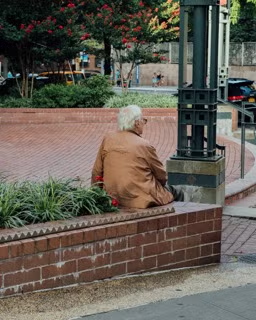
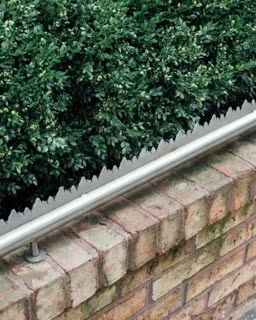
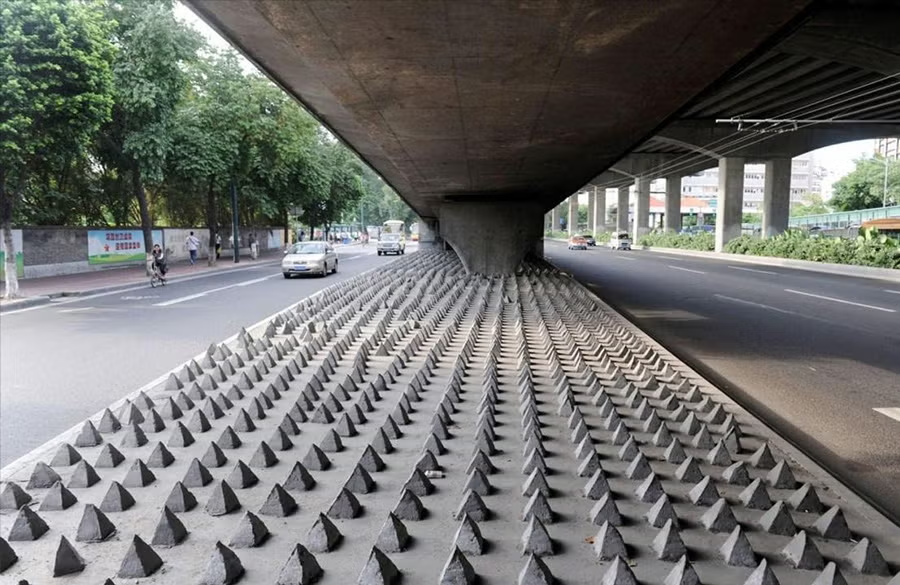
Instead of building public spaces with hostile architecture that keeps people out, cities should focus on structures that connect people. Public space is meant for everyone, yet the homeless are disproportionately affected. If we reconsider the fact that public spaces belong to everyone within the city, we can redistribute the ownership and remove the blame from homeless people. If the city is just a patchwork of neighborhoods and houses, then the city in some capacity also belongs to the people in the neighborhoods and houses. If we build a city that makes people feel like they belong, then a responsibility to protect and take care of the city will arise.
Redesigning Public Spaces
Third Places
The goal of redesigning public space is to create areas that feel welcoming and relaxing. That means that cities need more places known as “third places”. Third places are the locations that are separate from a person’s home (the first place) and their work (the second place) (‘Third Places’ as Community Builders, brookings.edu). These are the places where people meet each other, connect, and build a community. They can be local coffee shops, parks, playgrounds, or community gardens. Third places are ultimately public spaces specifically designed for gathering. The more third places a city has, the more opportunities there are to build a stronger community. Building a city with more public, third places that also have inviting architecture both brings communities together and reduces hostility towards homeless people.
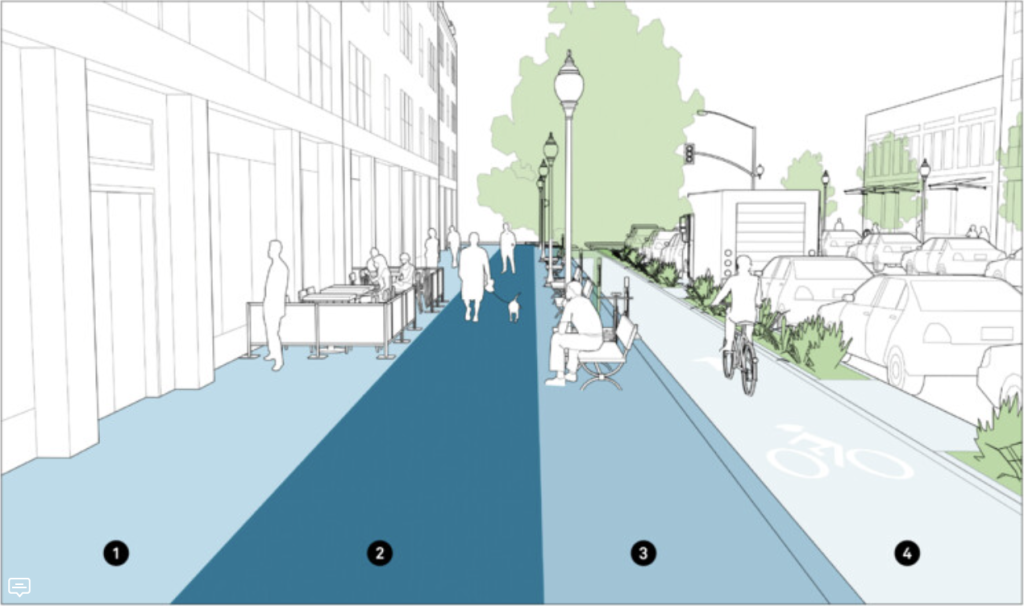
A way to build more third places is to redesign a city to have more pedestrian-only zones. Suburbs and the outskirts of a major city are typically the areas that lack the most third places. The transition areas between a city center and the suburbs can be utilized for third places. The large shopping centers that usually arise in suburban areas could be redesigned to reduce the parking lot space to put room for large walkways, bike lanes, and public transportation stops. Building centers between the city and the suburbs would allow people in both areas to come together. Reducing the space for cars and providing space for other types of transportation would decrease the need for a car and increase the opportunities for other types of mobility. Additionally, putting a public space between the city center and the suburbs would reduce the separation between the two, bringing resources to both areas and creating a more holistic community.
Bridging the Gaps
One of the main issues of urban sprawl and discontinuity in a city is transportation. With urban sprawl, the city center also becomes isolated just from the design of suburbs. Most suburbs are spread out, buildings are for single uses, houses are for single families, and are completely car-centered. Improving transportation options between city centers and suburbs increases connectivity between the two and allows people to easily access more third places and other resources.
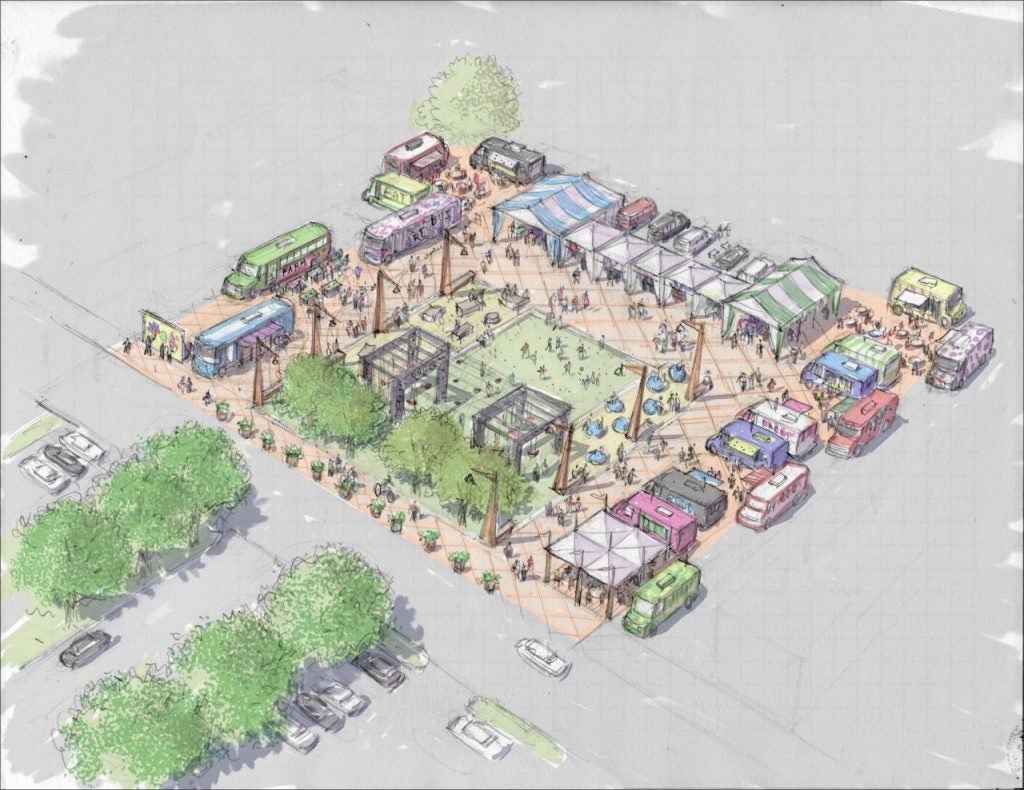
Specifically, within suburbs, the only mode of transportation is by car. One reason for this issue is that suburbs are often spread out and buildings are on a larger scale, leaving automobiles to be the most useful option. Since everything is so spread out, it makes it harder to build public transportation. Not only does public transportation need users, but it also needs specific stops. If everything is spread out, it makes it harder to find a central stop that is useful. So, my idea is to create third-place city centers both in suburban areas and between urban centers and the suburbs, which would open the space for the need for public transportation and create places for communities to form. The third-place centers could be a combined retail area and outdoor space that could be connected to other places in the city. Creating larger and more public spaces would also decrease the demand for a single space, which would allow for more equal distribution of public space between homeless people and non-homeless people. Instead of using the city space to build multi-lane highways, the city could create these third-place centers that also interconnect public transportation routes. There’s now an opportunity to build large walkways, bike paths, and tram lines. Making the suburb more accessible and mobile will hopefully increase opportunities to utilize more city resources and for more people to connect outside of their first and second locations.
Some examples of third places with useful transportation options:
Final Thoughts
Returning to the idea that nations are cities and towns, cities and towns are neighborhoods, and neighborhoods are just homes, we have to start thinking about how the way we build our homes, neighborhoods, and towns can create separation. When we build towns that are separate from each other, we lose the space to build third-place locations that are vital for community development. Public spaces become rival goods when they should be non-rival, and it opens the door to hostility toward homeless people. Homelessness happens for a variety of reasons, but when we create public spaces that keep people separate, we only aggravate the issue. Overall, if we build third places within the patchwork of homes, we add spaces and opportunities for growth and connection. When communities become closer, they become more empathetic and aware of each other’s struggles. Our urban design and how we view and appreciate public spaces ultimately have a much greater impact on how we interact with each other and how we view homelessness. Hopefully, we can create patchworks that connect each other and recognize where the issues of homelessness arise.
Works Cited
Desmond, Matthew, Evicted: Poverty and Profit in the American City, 1 March 2016.
Hu, Winnie, “‘Hostile Architecture’: How Public Spaces Keep the Public Out.” The New York Times, 8 November 2019, https://www.nytimes.com/2019/11/08/nyregion/hostile-architecture-nyc.html. Accessed 8 December 2022.
Global Design Cities Initiative, “Future planning methods for sidewalks and public transit space.” Archdaily, https://www.archdaily.com/989159/is-fixing-city-sidewalks-feasible-for-future-cities. Accessed 8 December 2022.
Photograph of concrete teeth under a bridge. Rethinking the Future, https://www.re-thinkingthefuture.com/designing-for-typologies/a2564-15-examples-of-hostile-architecture-around-the-world/. Accessed 8 December 2022.
Tachieva, Galina, “SprawlRepair_image1.” DPZ CoDESIGN, https://www.dpz.com/sprawl-repair-and-adaptation/#. Accessed 8 December 2022.
Tierney, MJ, “Aerial view of a massive highway intersection in Los Angeles.” Shutterstock, https://www.shutterstock.com/image-photo/aerial-view-massive-highway-intersection-los-512154394?src=Vk4-EvgfUQBmn8ygre518w-1-4. Accessed 8 December 2022.