
No matter the country, homelessness will exist. With an ever-increasing cost to live, a growing gap between the middle and upper class, and life changing events like pandemics and wars, it feels like homelessness is an inevitable side effect. Among countries around the world, homelessness rates range from nearly 0% to over 1%. These percentages may seem miniscule, but these tiny percentages can mean tens of thousands of people or hundreds of thousands of people homeless depending on the country, and if a massive country like China or even the US had just 1% of its population homeless, it would mean millions of people struggling to find a place to sleep, find food, or find happiness. It’s difficult to truly end homelessness, but that won’t stop us from trying to eliminate it, and the best way to figure out methods to end homelessness is to take the data we currently have on countries with differing degrees of homelessness and see what works and what doesn’t.
The homelessness rate will boil down to 3 factors: education, work, and living. Seeing how well the education system is in each country can determine how well a person’s future is set up, giving them a breadth of options to find work, but whether or not someone has an education, it depends on how easy it is to find employment, and how well that job can support their financial needs. Once someone finds a job, the cost of living in that country can vastly affect how much money they can actually spend to get through their daily lives, and the combined strength of each of these factors determine the effectiveness of each country keeping their society thriving.
There are three countries that we will analyze and compare: New Zealand, Australia, and Japan. Among these three countries, New Zealand has a relatively high homelessness rate at 0.86% (~41,000 people), Australia at a middle ground with 0.48% (~110,000 people), and Japan with nearly 0% (~3,000 people) of its population suffering homelessness. Each country has varying levels of homelessness, and by looking at how each country functions, there may be a correlation between the strength of a country and the amount of homeless people, which can help figure out methods to end homelessness once and for all.
Education
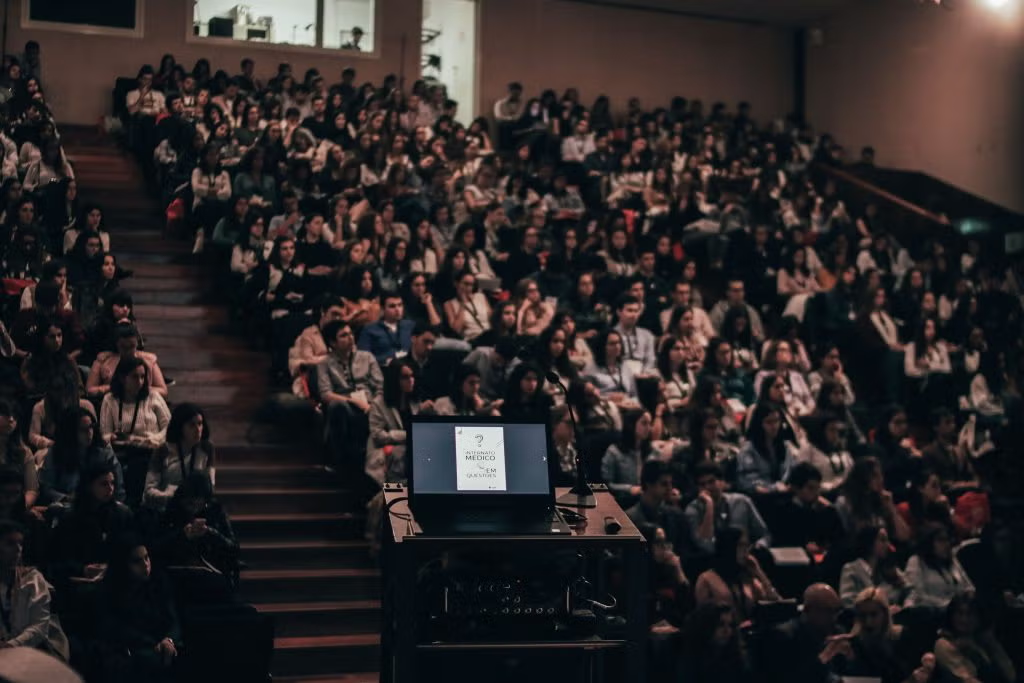
Arguably, the most important factor involved in trying to eliminate homelessness is education. With accessible education, both children and adults have the opportunity to gain knowledge and experience in different fields to find what fits them best, and having a school system helps student every step of the way helps keep the passion to learn and continue learning alive.
Most educations start when people are children. Starting young can snowball into higher and higher educations and eventually a job, and the younger you start can always help. All three countries have their compulsory education for primary school start at the age of 6, but pre-primary school isn’t required. Australia and New Zealand have low rates of children enrolled in pre-primary education, at 56% and 59% respectively, but Japan has an extremely high rate at 95%, but a much larger amount of children in Japan to grow familiar with the school environment to prepare for their primary education compared to Australia and New Zealand.
However, starting early isn’t the only mark of success, nor the most important. Moving forward to a higher education like college and obtaining a degree is a huge step in expanding your options in the search for money. Each country has varying levels of people who search for tertiary education. New Zealand has a rate of 45%, Australia with 54%, and Japan leading with 65%. The completion rate of these tertiary educations follow similar patterns, with Japan in first with 91% of those who enroll in tertiary education to complete it, with Australia middling in second at 72%, and New Zealand falling behind with a mere 58%.
The differing levels of education between countries are clear, especially as you go further up the intensity of learning, but why? Why is it that Japan has such a large gap between Australia and New Zealand? One of the more likely factors playing into this is the reason why you try to learn: money. The average cost of a college education in Japan is around 1 million yen per year. This equates to around 7-8 thousand USD every year, which is a fraction of the cost of Australia and New Zealand, whose costs equate to 15-33 thousand USD a year for Australia and 20-40 thousand USD a year for a bachelors degree in New Zealand. This drastically different cost in tuition shows how much more affordable it is to study in Japan over Australia and New Zealand, causing a paradox of needing to spend exorbitant amounts of money in order to make a larger amount of money.
Work

Whether or not you have an education, you need to make money to live, and you make money with work. The amount of people working in a country is integral in giving the population the ability to survive financially without being dependent on others, and it doesn’t matter if it’s a higher end job or lower income job, they should all be able to properly support someone to live a stable life.
Employment rates are huge. Seeing the rates of people who are actively searching for work and either succeeding or failing can reflect how a country handles their workforce. This time, the trend between countries differs ever so slightly. Japan again leads with an employment rate of 77.9%, but rather than Australia trailing with New Zealand at the back, New Zealand holds a slightly higher employment rate and 69.3% while Australia has a 64.3%. The high rate in Japan reflects on its low homelessness rate, but the similar rates in Australia and New Zealand don’t. The best explanation is most likely the population, where Australia’s population is 5x that of New Zealand’s, sitting around 25 million compared to New Zealand’s 5 million, and the larger population will make it more difficult to have such a high rate of employment due to the vast numbers you need.
A country can’t just have employment rates, however, especially if the actually wages can’t support the individual, even more if they have a family. Although it is dependent on the cost of living in the country, it’s good to set the standard of pay in each country. This time, countries are flipped over the head, with Japan averaging around 17 thousand USD per year, while Australia hovers around 90 thousand USD a year, with New Zealand in the middle at around 70 thousand a year. It seems crazy for Japan to have the lowest homelessness rates with such a low rate of income, but cost of living will be the biggest factor in how effective a countries wages are.
Living

The final factor into how homelessness can either be contained or grown is the standard of living. How affordable is it to buy homes, buy food, cover travel expenses, and go through other day to day costs. Obviously, the large problem with this is that we can’t get a huge general sense of ‘cost to live’ in a country because there a places that can be much cheaper than other places to live. So rather than taking the average across the country, we will view the cost to live in the most populated cities in each country.
In Japan, the city with the highest population is Tokyo, the capitol of the country. It’s the most expensive place to live within Japan, and daily costs like food, transportation, and other daily needs will be around $1000 per month for a single person, with rent being another $1100 per month, totaling to a little over 2000 USD per month. For Australia, it’s Sydney, where the cost to live is higher, being again $1000 per month for daily needs, but now around $1700 for rent, adding up to 2700 USD/month. Finally in New Zealand, we have Auckland, and we see that the cost to live is slightly lower than Sydney, being $1000 for daily needs and $1300 for rent, being around 2300 USD to live in Auckland.
Even though Japan had the best statistics among the other countries, relative to their working salaries, it actually is more expensive, yet they still have extremely low homelessness rates. One reason to why can tie back to education. In Japan, college costs are extremely small compared to Australia and New Zealand, and with tuition taking up the majority of overall costs, the lower salaries are made up for my the affordable college costs.
What now?
Education, work, and living. Each of these three factors play a part in the homelessness rates in a country, although some factors like education costs and employment rates have a stronger influence over others. There is no perfect fix to magically make the world perfect, and we can’t follow a successful country like Japan step by step because different countries have differing economies and political views. But just because we can’t change a lot doesn’t mean we can’t change at all. Lowering college costs, improving work conditions to encourage higher employment, and actually pay enough to give the population financial stability, and we’d be able to slowly march our way down the path to a world with a lot less homelessness, and a lot more homes.
References:
Hc3.1. Homeless Population – OECD. https://www.oecd.org/els/family/HC3-1-Homeless-population.pdf.
Education GPS, https://gpseducation.oecd.org/CountryProfile.
Australia – Overview of the Education System (EAG 2022) – OECD. https://gpseducation.oecd.org/CountryProfile?plotter=h5&primaryCountry=AUS&treshold=5&topic=EO.
New Zealand – Overview of the Education System (EAG 2022) – OECD. https://gpseducation.oecd.org/CountryProfile?primaryCountry=NZL&treshold=10&topic=EO.
“Ministry of Education – Education Counts.” A Closer Look at Completion in Higher Education in New Zealand, https://www.educationcounts.govt.nz/publications/80898/42059.
“Academic Fees.” Academic Fees|Planning Studies in Japan|Essential Guide for International Students Considering Study in Japan, https://www.studyinjapan.go.jp/en/planning/academic-fees/.
“Tuition Fees and Cost of Living.” Study with New Zealand, https://www.studywithnewzealand.govt.nz/en/why-new-zealand/living-in-new-zealand/cost-of-living.
StudyAdelaide. “How Much Does It Cost to Study in Universities in Australia?” StudyAdelaide, https://studyadelaide.com/whats-happening/how-much-does-it-cost-study-universities-australia.
Plc, GlobalData. “Employment Rate in Japan (2010 – 2021, %).” GlobalData, https://www.globaldata.com/data-insights/macroeconomic/employment-rate-in-japan-2137609/#:~:text=Employment%20Rate%20in%20Japan%20%282010%20-%202021%2C%20%25%29,the%20employment%20rate%20in%20Japan%20increased%20by%2010.8%25.
“What Is the Average Starting Salary in Japan? and Which Companies Pay the Highest Starting Salaries?” Blog, 20 Mar. 2021, https://resources.realestate.co.jp/living/what-is-the-average-starting-salary-in-japan-and-which-companies-pay-the-highest-starting-salaries/.
“Labour Force, Australia, October 2022.” Australian Bureau of Statistics, https://www.abs.gov.au/statistics/labour/employment-and-unemployment/labour-force-australia/oct-2022.
“Average Weekly Earnings, Australia, May 2022.” Australian Bureau of Statistics, https://www.abs.gov.au/statistics/labour/earnings-and-working-conditions/average-weekly-earnings-australia/latest-release.
“Employment Rate: Stats NZ.” Employment Rate | Stats NZ, https://www.stats.govt.nz/indicators/employment-rate.
“Salary Guide.” Careers.govt.nz, https://www.careers.govt.nz/job-hunting/whats-happening-in-the-job-market/salary-guide/.
“Cost of Living in Auckland.” . Dec 2022. Prices in Auckland, https://www.numbeo.com/cost-of-living/in/Auckland.
“Cost of Living in Tokyo.” . Dec 2022. Prices in Tokyo, https://www.numbeo.com/cost-of-living/in/Tokyo.
“Cost of Living in Sydney.” . Dec 2022. Prices in Sydney, https://www.numbeo.com/cost-of-living/in/Sydney.
Tyson, Jon. “Photo by Jon Tyson on Unsplash.” Beautiful Free Images & Pictures, 19 Dec. 2020, https://unsplash.com/photos/rbz1hVh7_LM.
Henriques, Miguel. “Photo by Miguel Henriques on Unsplash.” Beautiful Free Images & Pictures, 11 Dec. 2018, https://unsplash.com/photos/-8atMWER8bI.