The Issue:
The homelessness crisis in the United States is no secret. With upwards of 580,000 homeless people in the U.S. and the number steadily increasing there is a growing urgency to find a solution. There are two approaches to addressing this issue: the prevention of homelessness and the protection of those who are already unhoused. The current policies in place in the United States are not sufficient in combating homelessness effectively. Homeless people within the U.S. report the lack of affordable housing, domestic violence, and insufficient wages as reasons for their homelessness. These causes are indicative of systemic issues in the policies surrounding homelessness prevention and care. A recent report by the National Low Income Housing Coalition found that every single US state has an insufficient amount of affordable housing for its residents. Not only that but shelters are almost constantly running at capacity and often have to turn people seeking refuge away. This report highlights what so many homeless people already know to be true: there just aren’t enough places to live in the United States.
In the United States, stories like that of Olivia and Alex are not uncommon. Olivia is a single mother who, along with her son Alex, were evicted from their apartment because Olivia could not afford to pay rent. Olivia was only able to afford the fees to stay in a hotel because of the Lutheran Social Services group, a non-profit aimed at supporting those in danger of living without shelter. Olivia’s lifeline consisted of a set of volunteers instead of a government-backed guaranteed source of aid. Although the county was able to provide Olivia with 28 days free of cost in the motel, the volunteer-based organization was able to give her three months. Olivia credits them and not the county with her ability to stay off the streets. This reliance on the kindness of others and lack of guaranteed and consistent aid is a source of frustration with many homeless communities. Without enough affordable housing and minimal support from the government when it comes to finding temporary shelters many find it impossible not to end up on the street.

Unfortunately, currently homeless populations do not only have to face insufficient housing and shelter availability, they also are left to fend for themselves when it comes to their safety and well-being. In fact, many face criminalization for struggling with addiction or for being involved in sex work. In the United States sex work is illegal (with the exception of certain districts in Nevada). Those in active addiction are afraid to come forward for help in fear of being arrested. Similarly, those engaging in survival sex, a form of sex work out of necessity to survive, are reluctant to come forward to report rape, coercion, and abuse in fear of being arrested and/or prosecuted. Additionally, the criminalization of sex work prevents many participants from seeing medical professionals leading to higher rates of untreated STIs and long term health consequences. Ka’ek’e, a pregnant woman living on the streets in Minnesota, details her experience with survival sex as she navigated homelessness on her own. Ka’ek’e describes how she has to resort to couch hopping in order to find a place to sleep for the night which often means having to turn to survival sex as a means for paying for her accommodation. She goes as far as to say, “you gotta sell yourself so you can be able to make it. I don’t even know who my baby’s daddy is” (0:24). Left to fend completely for herself Ka’ek’e describes how she is often coerced into sex under threat of eviction and how often men don’t pay her. Ka’ek’e cannot report these crimes to local authorities as sex work is illegal in the state of Minnesota and she is left to her own devices when it comes to navigating survival sex and homelessness.
Who Can We Look To?
Homelessness is not a uniquely American issue, in fact, it is a widespread issue with very few countries efficiently combating it. However, Finland and Germany are both making substantial progress when it comes to developing policies aimed at both homelessness prevention and the protection of these vulnerable communities. These countries have made affordable housing central to their fight against the growing homelessness crisis and use the decriminalization of addiction and sex work as a means of supporting the currently homeless.
Finland
Finland has a distinctive and radical approach when it comes to affordable housing. The “Housing First” initiative was introduced in 2007 and made housing available to virtually anyone. The policy follows the ideology of providing housing without any preconditions. Rather than require occupants to become sober or have a stable source of income prior to receiving an apartment they are given a permanent residence and continuous aid from the government. This way they receive the support they need to become self-sufficient. A social worker is assigned to each individual who requests help from a crisis center specific to homelessness. This social worker will not only help find a permanent place for the individual to live but will also help them find secondary support systems like addiction care or domestic violence counseling. These secondary support systems are vital when it comes to giving people their independence and self-sufficiency back. Until they are able to pay their own rents and depending on income and numerous other factors, ranging from disability status to age, the government will cover the cost of the living arrangements.
This approach has seen great success in Finland with the reported number of homeless people hovering at around just 5,000 and steadily decreasing. It is expected that Finland will have eradicated homelessness completely by the year 2027.
Although initially met with some pushback from taxpayers, Finland has actually been saving money with this initiative. By providing meaningful support that treats the root causes of homelessness rather than having to repeat temporary solutions Finland has managed to combat homelessness without any major fiscal losses.

Finland has also made recent improvements in the decriminalization of sex work aimed at preventing the abuse and exploitation of vulnerable populations. With the new regulations sex work is legal as long as there is no solicitation is public areas and there is no organization or third party directly profiting. If either of these conditions are met the buyer can be criminalized rather than the sex worker. This allows sex workers to report crimes and seek medical attention without the fear of being prosecuted.
Germany
Germany’s approach is not as aggressive as that of Finland and is thus less effective. German law states that people at risk of losing their homes are entitled to some type of government assistance which can take the form of loan or debt alleviation. This policy was drafted with the intention of preventing those at risk of losing their home from being evicted and ending up on the street. Additionally, Germany requires that municipalities have emergency housing centers and temporary accommodations be widely available and accessible throughout the country. This approach puts emphasis on temporary aid and does not guarantee any form of permanent housing. Although Germany is in the process of discussing the “Housing First” approach as modeled in Finland, the current methods in place treat the symptoms of homelessness rather than the root causes. With less emphasis put on permanent housing and rehabilitation Germany has not seen the same decline in homelessness that Finland has witnessed.
Germany does, to some extent, provide secondary support systems in the form of soup kitchens, counseling centers, medical care, and day centers. These available resources are designed with the intention of helping homeless communities get the care they need to treat mental health conditions, chronic illnesses, and can help community members find employment and fill out housing applications. These systems are not adequate replacements for permanent housing but they do help provide homeless communities with valuable resources.
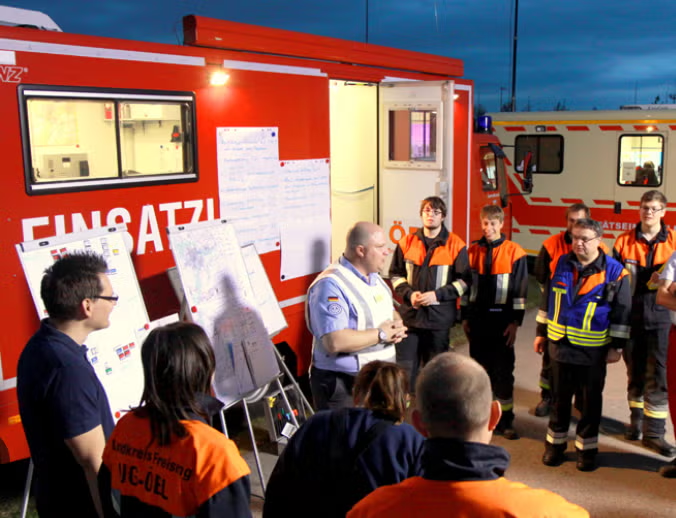
Similarly to Finland, Germany has legalized sex work (although certain aspects of its legality are still decided by local governments). Germany has designated red light districts where solicitation is legal and recent laws require sex workers to register in order to legally operate. This registration calls for a renewal every two years and mandatory meetings to undergo counseling with a social worker. While the legalization of sex work has provided sex workers with a safer environment, the registration and counseling requirement helps to ensure that they are not being abused or mistreated. Passing laws to decriminalize sex work has helped better the working conditions for sex workers across Germany and protect homeless people who have turned to survival sex.
Final Thoughts
As effective as these policies are, it is important to keep in mind the differences between the U.S. and these countries. Just based on size alone, the implementation of these policies in smaller countries like Finland and Germany is significantly easier than in a large country like the United States. However, while it is unreasonable to make policies identical to those of Finland and Germany, these approaches to homelessness should absolutely be used as guidelines and thoroughly considered as possible options when it comes to tackling the issue in the United States.
Works Cited
Essi Thesslund Sam Okyere, et al. “The False Promise of the Nordic Model of Sex Work.” OpenDemocracy, 17 Apr. 2018, https://www.opendemocracy.net/en/beyond-trafficking-and-slavery/false-promise-of-nordic-model-of-sex-work/.
Federal Ministry of the Interior and Community. “Crisis Management.” Federal Ministry of the Interior and Community, Federal Ministry of the Interior and Community, 8 Nov. 2022, https://www.bmi.bund.de/EN/topics/civil-protection/crisis-management/crisis-management-node.html.
Gold, Kerry. “’Simply Not an Option’: How Finland Is Solving the Problem of Homelessness.” The Globe and Mail, The Globe and Mail, 13 Aug. 2021, https://www.theglobeandmail.com/real-estate/vancouver/article-simply-not-an-option-how-finland-is-solving-the-problem-of/.
Homelessness in America: Overview of Data and Causes. https://homelesslaw.org/wp-content/uploads/2018/10/Homeless_Stats_Fact_Sheet.pdf.
“Homelessness Statistics.” National Alliance to End Homelessness, 27 July 2021, https://endhomelessness.org/homelessness-in-america/homelessness-statistics/.
“Housing Is a Human Right: How Finland Is Eradicating Homelessness | CBC Radio.” CBCnews, CBC/Radio Canada, 19 Aug. 2020, https://www.cbc.ca/radio/sunday/the-sunday-edition-for-january-26-2020-1.5429251/housing-is-a-human-right-how-finland-is-eradicating-homelessness-1.5437402.
“Ka’e K’e Is Pregnant, and Because of Survival Sex She Does Not Know Who the Baby’s Daddy Is.” Invisible People, 7 Oct. 2018, https://invisiblepeople.tv/videos/kae-ke-homeless-pregnant-st-paul/.
Lopez, German. “Homeless in America.” The New York Times, The New York Times, 15 July 2022, https://www.nytimes.com/2022/07/15/briefing/homelessness-america-housing-crisis.html#:~:text=America’s%20homelessness%20problem%20has%20the,also%20probably%20rising%2C%20experts%20say.
“New Report Shows Inadequate Supply of Housing in Every. Single. State.” Invisible People, 9 Oct. 2022, https://invisiblepeople.tv/new-report-shows-inadequate-supply-of-housing-in-every-single-state/.
Thelwell, Kim. “Homelessness in Germany on the Rise.” The Borgen Project, Kim Thelwell Https://Borgenproject.org/Wp-Content/Uploads/Logo.jpg, 18 Jan. 2020, https://borgenproject.org/homelessness-in-germany-on-the-rise/#:~:text=Housing%20Rights%20in%20Germany&text=Law%20requires%20German%20municipalities%20to,temporary%20and%20emergency%20housing%20services.