
Critical Reading & Discourse – The Challenges We Face
Objective
The goal of the critical reading and discourse exercises is to explore how our attitudes and behaviors are related to different global change issues. We will read articles from the WorldWatch Institute designed to provide a framework for lively classroom discussions and activities. Then we will discuss questions related to the individual articles to better understand our role in global change.
This lab will introduce a broad spectrum of concepts related to global environmental change and the challenges that go along with those changes. We will explore the current state of the world and the challenges we face in relation to global change and sustainable development. We will discuss an article from the WorldWatch Institute entitled A History of Our Future P. 3-13, which gives a broad overview of the kinds of pressing environmental and social issues that we, as a society, are facing.
Before Coming to Discussion Section
First,
Read the article from WorldWatch Institute Challenges We Face – A History of Our Future – 2003 State of the World p. 3-13.
Read the article by Steffen in Solutions How Defining Planetary Boundaries Can Transform Our Approach to Growth – p. 1-8.
Reflect on the United Nations DPSIR (Driving Forces – Pressures – State – Impacts – Response) framework in relation to global change problems.
Explore the State of the Planet and the Planet Under Pressure graphic modules.
Then… (skip to after graphics)
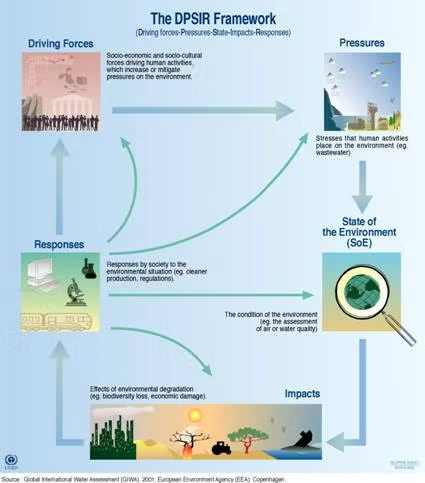
Figure 1 – DPSIR Framework
More Graphics from GRID-Arendal:
The driving force – pressure state – impacts – response framework
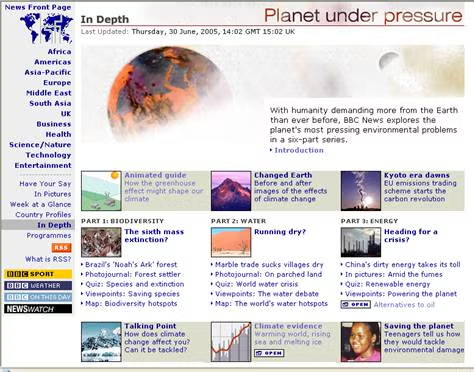
Figure 3 – Planet Under Pressure Module
Planet Under Pressure Interactive Module
…Then,
Think about the topics discussed in the article and graphic modules that you consider to be the most pressing environmental challenges that we face, as a global society today. Are there other environmental or social problems that you feel are important that the article or graphic module do not address? What are they?
Consider the topics that you believe to be most important, in relation to the DPSIR (Driving Forces – Pressures – State – Impacts – Response) framework. For example, if you think that the availability of fresh water resources is the most pressing environmental challenge that humans are facing, apply that problem to the DPSIR framework. For instance, consider:
- What human activities are causing the problems associated with fresh water resources?
- How dire is the state of our freshwater resources?
- What types of strategies could we implement to help solve problems associated with fresh water availability and quality?
- Does the driver-response model change the way they think about the issue?
Develop and write down two questions for discussion section about topics that you found most interesting and most pressing. Your questions should be developed to either:
- Promote discussion (at least one of the two)
- To answer questions that you did not understand (i.e., the author’s logic, the scientific basis for the author’s assertions, etc.).
Bring your questions and your enthusiasm for a lively discussion to class with you.
Questions for Discussion
Question 1
Summarize the five threats presented in the Challenges We Face article. What kinds of steps are being taken to remedy each of these threats? Are we doing enough?
Question 2
Do we face other threats, not addressed in the article? What actions are needed to manage these challenges?
Question 3
What is the difference between a generalist and a specialist species? How might generalist species like us, affect specialists? Should humans be concerned with altering the environment where specialists reside?
Question 4
The article states that, “we have a paralysis of hope.” What does this mean? How can we overcome this?
Individual Assignment: After Discussion
Write a one page double-spaced report answering the following questions:
Question 5
Based on your lab’s discussion and the article you read, what do you believe is the most pressing environmental issue today? Why?
Question 6
Describe how you would apply your problem to the DPSIR (Driving Forces – Pressures State – Impacts – Response) framework.
Question 7
Did your lab’s discussion change your opinion, if so how, and if not, why not? Make sure to use and cite information presented in the article or graphic module to support your opinions.
Answer the above questions in a Word document and hand in on Canvas under your lab section. You