
What is the Sexual Citizenship class?
Sexual Citizenship (Sociology 223/Social Work 223) explores why sexual misconduct remains a challenge in campus life. In this course, you’ll discover what sexual citizenship is and how it connects with race, gender, sexual orientation and other identities to shape experiences with gender-based violence. You will examine the structural and cultural factors that impact this issue on campuses, from the geography of campus spaces to social norms about gender and relationships. You will engage with contemporary research on sexual ethics and comprehensive sex education. Finally, the course looks at how student activism, institutional policies, and community engagement can help foster a safer campus environment. This course offers a meaningful way to understand and influence the campus culture around you.
What is the course workload?
Students will complete assignments designed to encourage engagement, reflection, and application of course concepts related to sexual citizenship, sexuality, gender, and campus culture. These include active participation in lectures and discussions, pre- and post-course surveys that assess learning and growth, a brief weekly reflection journal, and a short participant-observation memo that applies course concepts to a real-world event. Throughout the course, students will critically examine social norms, power, identity, and relationships while connecting course material to their own experiences and observations. The course culminates in a 3-5 minute teach-out project, where students develop and present an evidence-informed initiative to increase sexual education knowledge or reduce sexual and gender-based violence on college campuses.
Grading Scale:
| 99-100 = A+ | 78-79 = C+ |
| 93-98 = A | 73-77 = C |
| 90-92 = A- | 70-72 = C- |
| 88-89 = B+ | 68-69 = D+ |
| 83-87 = B | 63-67 = D |
| 80-82 = B- | 60-62 + D- |
**59 and below = E
Who are the instructors?
Dr. Samantha Leonard (she/her)
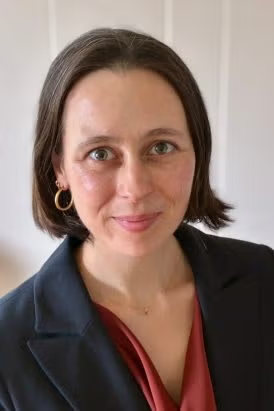
Dr. Leonard studies gender and sexuality, gender-based violence, and social movements and social change. In her scholarly and pedagogical work, she is interested in exploring the intersections of power, gender, sexuality, and violence through questions on the cultural, temporal, and institutional dimensions of sexual and gender-based violence and its prevention and resistance. Her current research and book project focuses on how social service providers and activists in the United States and Argentina prevent, respond to, and resist intimate partner and sexual violence. In other recent projects, she has examined the social architecture of collective violence and gendered experiences of economic inequality and precarity.
Dr. Katherine Holstein Mercer (she/her)
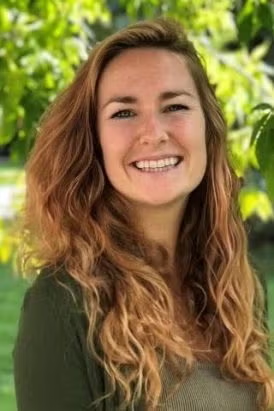
Dr. Mercer uses qualitative methods to explore social control and norm creation/enforcement, particularly in the realm of sexuality and gender. Her most recent research explores consent norms creation and enforcement in alternative sexual communities. She has published in the Journal of Sex Research, Social Science and Medicine, and Sociological Perspectives.
Why should you take the class?
- Earn 2 Social Science Credits
- Earn up to $500
- The course is only 7 weeks long!
- Lecture/discussion sections offered during convenient (off-peak) times
- Flexible way to reach your 15-credit goal, particularly if you have to drop a class
- Counts toward the Community Action & Social Change minor and the 4+1 Sociology & Social Work sub-major in Sociology
- You can help other students learn how to maintain healthy relationships, increase sexual health, and prevent campus sexual misconduct
- You can help U.S. universities learn how to provide a safe learning environment for all students
Why are the students who take this class compensated?
We compensate the students who take and pass this class because it is more than “just” a class. SOC/SW 223 is actually a novel educational intervention and part of a long-term research study. The students who take it complete up to eight research surveys over the course of their time in college, starting from their freshman year to their senior year. People who participate in research are commonly paid for their time and labor, so we do the same!